
Here is your plain-English guide to action, linking, helping, regular, irregular, transitive, and intransitive verbs — with real student mistakes, wrong-vs-correct examples, and an interactive practice test you can solve right on this page.
Look at the world around you. People talk, think, run, sleep, laugh, feel, and ask questions every day. These are all things we do, experience, or become, and in English, we use verbs to show them.
So, what is a verb in English grammar?
SIMPLE DEFINITION
A verb is one of the most important parts of a sentence. It tells us what the subject does, feels, or is. Without a verb, a sentence cannot express a complete idea. It is one of the main parts of speech.
Here are some easy examples to understand what a verb is.
- Ansa reads the novel.
- She feels happy after the gym.
- Kids run in the park.
- We study English every day.
- I wake up early.
In this guide, we will explore the main types of verbs with simple examples so beginners can understand verb meaning, spot verbs quickly, and avoid common mistakes. You will also find a short practice test at the end to test your understanding.
The Two Main Types (Learn These First)
Before anything else, every verb falls into one of these two big groups. Everything else you’ll learn later is just a more detailed way of looking at these.
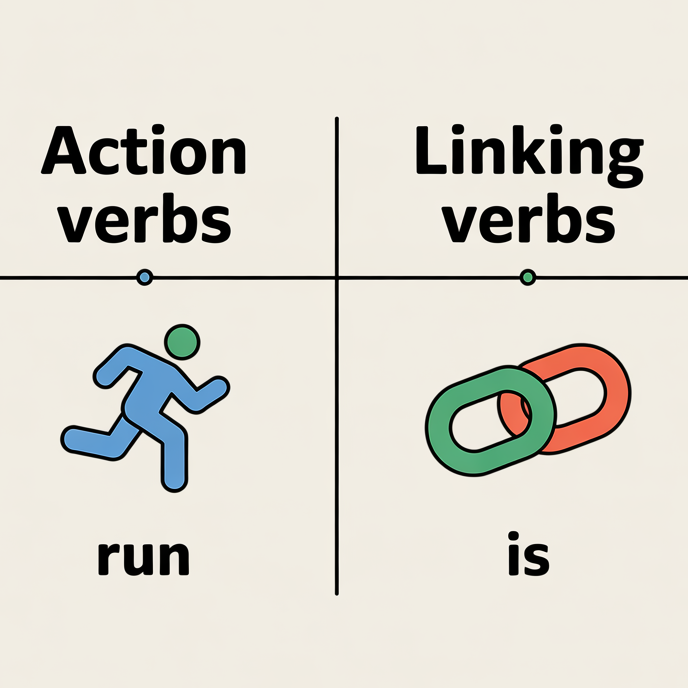
1. Action Verbs
SIMPLE DEFINITION
Action verbs, also called dynamic verbs, show physical or mental actions or movements. They describe what someone or something does. They often answer “what is happening?” in a sentence.
We perform actions in two ways:
- Physical (running, eating)
- Mental (thinking, deciding)
Physical actions are the actions we perform with our body, such as writing, jumping, eating, singing, etc.
Mental actions are actions performed in the mind, such as thinking, imagining, considering, deciding, etc.
For example, when we think about an upcoming party or consider our past life, we are doing mental actions.
He happy at night. (no verb — incomplete)
He writes poems at night.
“Writes” is the action verb — it tells us exactly what he does. A sentence needs a real verb, not just a description word.
Example Sentences:
- He plays football.
- Frogs jump over puddles.
- Birds sing at dawn.
- Sadaf decided to leave the party.
- She imagines meeting her mentor.
2. Linking Verbs
SIMPLE DEFINITION
Linking verbs do not show action. Instead, they connect the subject to a description or identity (is, am, are, was, were, seem, become, look, feel, smell, sound, taste).
Hira doctor. (missing linking verb)
Hira is a doctor.
“Is” links “Hira” to “a doctor” — no action is happening, just a connection between subject and identity.
A linking verb links the subject to:
Examples Sentences:
- The sky looks cloudy.
- Biya is a student.
- The soup smells delicious.
- Mahid seems tired today.
- They became friends.
- Cotton feels soft.
- Stars appear bright tonight.
“Feel” can work both as a linking and action verb:
Why is “feel” sometimes a linking verb? It is sometimes a linking verb because it links the subject to a description.
- She feels happy.
Here, “feels” connects the subject with the adjective “happy.”
But “feel” can also show action.
- I feel the texture of the cloth.
Here, “feel” shows an action.
So the meaning depends on the sentence.
Simple Clarification for Beginner Learners:
The main (basic) types of verbs are usually just these two big categories: Action and Linking Verbs.
Everything else (helping, modal, transitive, intransitive, regular, irregular) is a subtype — they describe verbs from different angles, not separate “levels.” Think of it like this: a single verb can belong to more than one category at the same time.
Here’s how they fit together:
By meaning/function (the main split):
- Action Verb
- Linking Verb
Whether they need help:
- Main Verb (stands alone)
- Helping/Auxiliary Verb (supports main verb) — includes Modal Verbs (can, could, must, etc.)
By whether they need an object:
- Transitive Verb – needs an object.
Example: She eats an apple. (apple = object) - Intransitive Verb – doesn’t need an object.
Example: She sleeps.
Or how they change tense/form:
- Regular Verb – forms past tense by adding -ed.
Example: walk → walked - Irregular Verb – changes form differently, not with -ed.
Example: go → went
However, I’m further explaining helping verbs, transitive and intransitive verbs, and regular and irregular verbs, as these are easy-to-understand subtypes of verbs.
Other Important Verb Types
These are subtypes — they look at verbs from a different angle (help, tense, or object) rather than a separate “level.” A single verb can belong to more than one category at once.
3. Helping Verbs (Auxiliary Verbs)
A helping verb supports the main verb to build tense, questions, negatives, or passive voice. It doesn’t convey the core meaning on its own.
She eating breakfast.
She is eating breakfast.
“Eating” alone can’t stand as a complete verb here — it needs the helping verb “is” to form the correct tense.
Example Sentences:
- Miral is eating an apple.
- I have finished my homework.
- Soha does not like tea.
- Do you speak English?
- I will call you tomorrow.
- He can swim very well.
- They must leave now.
Common Helping Verbs:
- Be verbs: is, am, are, was, were, be, being, been
- Have verbs: have, has, had
- Do verbs: do, does, did
- Modals: can, could, may, might, must, shall, should, will, would
Quick tip: Helping verbs always come before the main verb in a sentence.
Example: She is (helping verb) reading (main verb) a book.
4. Regular vs Irregular Verbs
Verbs can also be grouped by how they change into the past tense. This gives us two types: Regular Verbs and Irregular Verbs.
Regular verbs are predictable. To talk about the past, you add -ed or -d to the end of the base form of the verb.
She goed to the market yesterday.
She went to the market yesterday.
“Go” is irregular — it doesn’t follow the “-ed” rule, so “goed” is not a real word.
- Walk → walked: I walked to school yesterday.
- Play → played: She played the piano beautifully.
- Talk → talked: We talked for hours last night.
Alternatively, Irregular verbs are unpredictable. They do not follow the -ed rule for past tense and past participle. Instead, they change their spelling entirely, or sometimes stay the same. You just have to memorize them.
- Go → went → gone: She went to the market yesterday.
- Eat → ate → eaten: I have eaten all the cookies.
- See → saw → seen: We saw a beautiful bird.
Quick Tip for Learners: If a verb ends in -ed in the past tense, it’s regular. Also, if it changes completely (like go → went), it’s irregular!
| Base (V1) | Simple Past (V2) | Past Participle (V3) | Rule applied | Category |
| Clean | Cleaned | Cleaned | Standard -ed | Regular |
| Write | Wrote | Written | Vowel change | Irregular |
| Open | Opened | Opened | Standard -ed | Regular |
| Drive | Drove | Driven | Vowel change | Irregular |
| Watch | Watched | Watched | Standard -ed | Regular |
| Buy | Bought | Bought | Spelling shift | Irregular |
5. Transitive and Intransitive Verbs
Verbs can also be grouped by whether they need an object to complete their meaning. This gives us two types: Transitive Verbs and Intransitive Verbs.
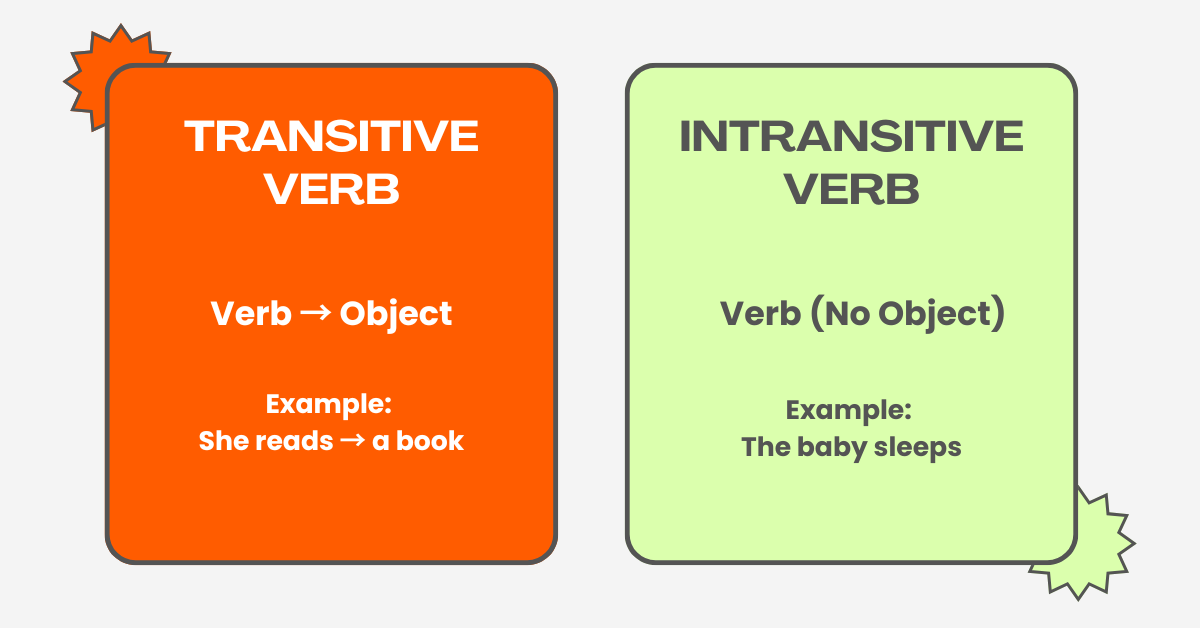
Transitive verbs require a direct object to complete their meaning. Without an object, the sentence feels incomplete.
- Nida drinks water.
- They buy groceries.
- The boy kicks the ball.
- I read a book.
- We cleaned the room.
- Sia closed the door.
- I love my family.
Intransitive verbs are verbs that do not need an object. The sentence is complete by itself with just the verb.
- We laugh together.
- Please sit down.
- She sleeps early.
- The baby cried.
- Usman smiled.
- The sun rises.
- Iqra sneezed.
He arrived the station. (needs a preposition, not an object)
He arrived at the station.
“Arrive” is intransitive — it can’t directly take an object like “the station.” You need “at” first.
Verb Confusion: Real Examples from Student Writing
Mistake 1 — Dropping the linking verb
She very intelligent girl and she know everything.
She is a very intelligent girl, and she knows everything.
Mistake 2 — “-ing” with a stative verb
I am understanding this lesson.
I understand this lesson.
Mistake 3 — Forgetting subject-verb agreement
He go to school daily.
He goes to school daily.
Mistake 4 — Direct translation of “main sahmat hoon”
I am agree with you.
I agree with you.
Mistake 5 — Wrong irregular past form
I bringed vegetables from the market.
I brought vegetables from the market.
More Verb Examples (Natural, Everyday Sentences)
- My phone battery died again.
- This tea tastes amazing.
- I’ve been waiting for almost an hour.
- She didn’t reply to my message.
- Traffic is getting worse every day.
- He owes me five hundred rupees.
- Honestly, I don’t feel like cooking tonight.
- They just moved to a new flat.
- Can you believe it’s already July?
- The Wi-Fi keeps disconnecting.
- We ran out of milk this morning.
- She sounded upset on the phone.
- I forgot my umbrella at home.
- He seems nervous about the interview.
- Let’s see what happens next.
Quick Recap
- Action verbs show what the subject does.
- Linking verbs connect the subject to a description or identity — no action.
- Stative verbs describe a state, feeling, or belief — avoid “-ing” with these.
- Helping verbs support the main verb to build tense, questions, or negatives.
- Regular verbs add “-ed”; irregular verbs change form and must be memorised.
- Transitive verbs need an object; intransitive verbs don’t.
Below is the practice test for verb understanding; solve it yourself and check the result.

Leave a Reply