
“I like English and I want to improve and I study every day because I want a good job.”
Sound familiar? This is exactly how most beginners write — stringing sentence after sentence together with and and because, which often creates long, repetitive, or awkward English, especially in exam writing, WhatsApp messages, and CVs.
In this simple conjunctions guide, you’ll learn the types of conjunctions, see wrong vs correct examples, avoid common mistakes, and finish with a short practice test.
Try Practice Test Below!What Are Conjunctions in English Grammar
SIMPLE DEFINITION
Conjunctions mean “to join together.” They are linking words that connect words, phrases, clauses, and ideas — words like and, but, because, and although.
They are an important part of Parts of Speech, helping you say, “I like tea and coffee,” or “I stayed home because it rained,” joining thoughts naturally. Without them, our sentences would be short, abrupt, and confusing — or worse, they’d run on forever, like the example at the top of this post.
These words help show relationships between ideas. For example, you can show addition, contrast, reason, result, or choice. By using conjunctions, you can combine simple sentences into complex, meaningful ones, making your writing more interesting and professional.
The real-world problem: most learners don’t struggle with knowing what a conjunction is. They struggle with:
- Run-on sentences — joining too many ideas with “and” instead of breaking them up or using a stronger conjunction.
- Repetitive and — using “and” everywhere instead of “but,” “so,” “while,” or “whereas.”
- Wrong use of because/so — mixing up cause and result in the same sentence.
Fixing these three habits alone will make your English sound noticeably more advanced.
Examples of Conjunctions in Action
- Addition: I like tea, and she likes coffee. (joins two ideas of equal importance.)
- Contrast: I wanted to go to the park, but it started raining. (Contrast between two ideas.)
- Cause and Effect: He stayed home because he was feeling sick. (Why something happened.)
- Choice & Alternative: You can have tea or coffee. (Gives two alternatives.)
Types of Conjunctions
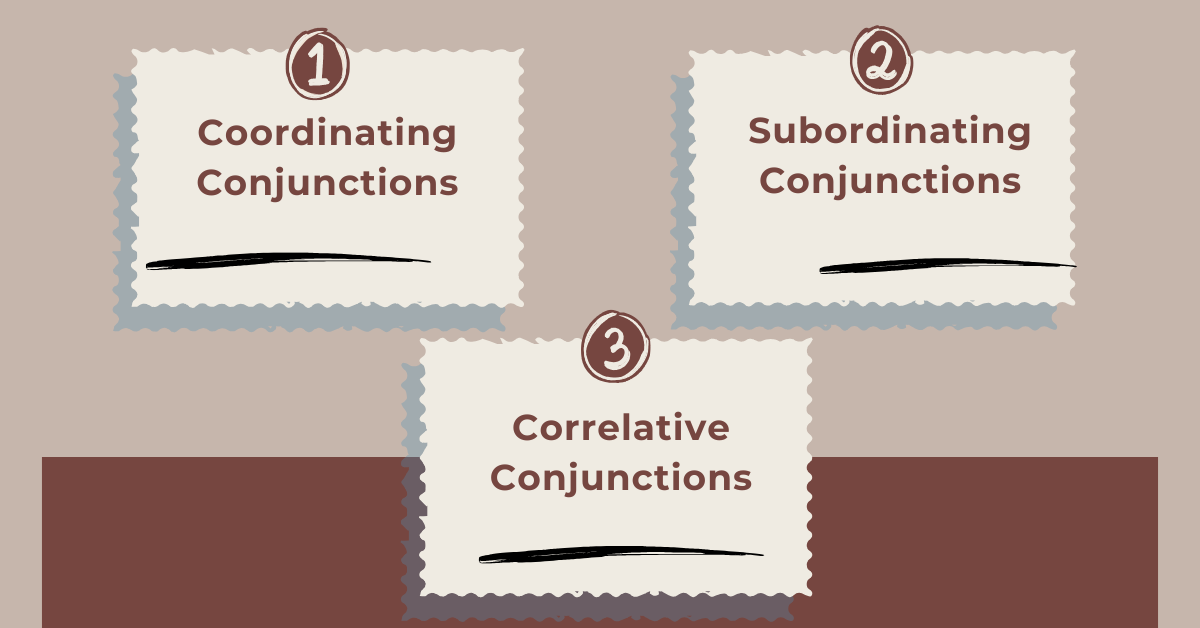
Types of conjunctions fall into three basic categories:
- coordinating conjunctions
- Subordinating conjunctions
- Correlative conjunctions
| Type | Function | Example |
|---|---|---|
| Coordinating | Connect equal sentence parts | and, but, or, so |
| Subordinating | Connect dependent and independent clauses | because, although, while, if |
| Correlative | Work in pairs – link balanced ideas | either…or, neither…nor |
Coordinating Conjunctions
SIMPLE DEFINITION
Coordinating conjunctions are words that connect two or more ideas of equal importance. They are used to join independent clauses, words, or phrases in a sentence.
The FANBOYS mnemonic is the best trick or pattern that helps you remember the seven coordinating conjunctions:
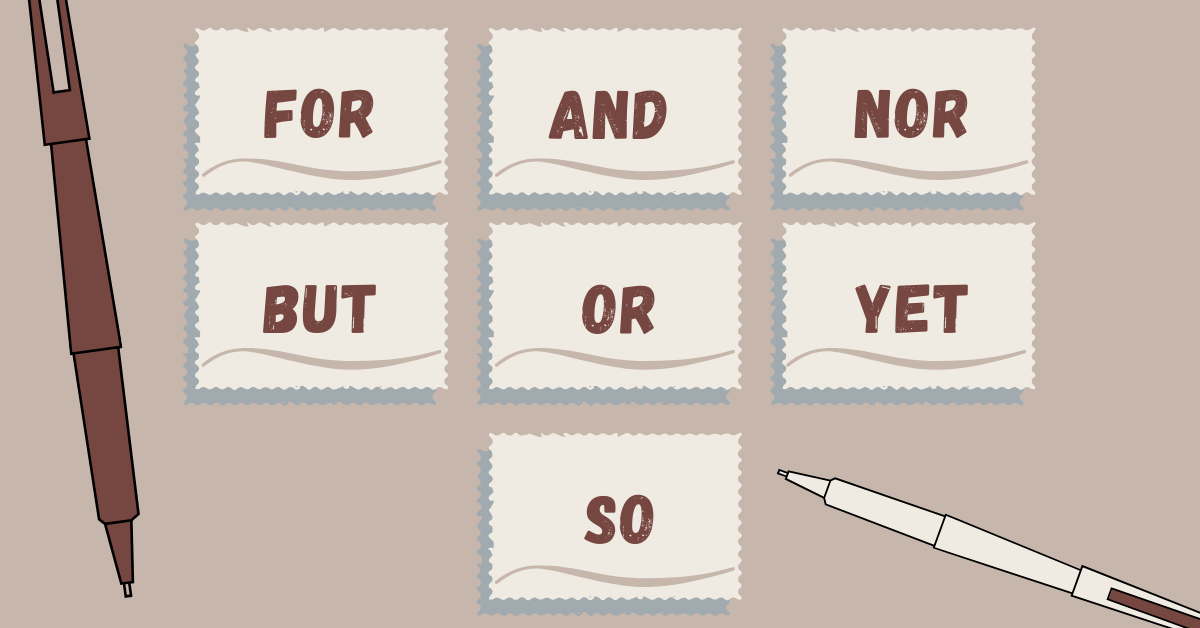
– For (reason)
– And (addition)
– Nor (negation/alternative)
– But (contrast)
– Or (choice/alternative)
– Yet (contrast, similar to but)
– So (result/effect)
These are very common in English, but learners often use them too much or place them incorrectly. A frequent problem is joining two complete sentences without proper punctuation.
I was tired, and went to bed.
I was tired, so I went to bed.
Rule: Here, and does not show the result. It just adds information. So is the better choice because it shows cause and effect.
Common Mistakes with FANBOYS
I woke up late I missed the bus and I was upset.
I woke up late, so I missed the bus, and I was upset.
She likes coffee she doesn’t like tea.
She likes coffee, but she doesn’t like tea.
He studied hard he still failed the test.
He studied hard, yet he still failed the test.
Simple Rules:
- Always use a comma before FANBOYS when connecting full sentences.
- Don’t overuse one conjunction repeatedly; mix them for better flow.
- Remember: coordinating conjunctions connect ideas of equal importance—use subordinating conjunctions for unequal ideas.
Subordinating Conjunctions
SIMPLE DEFINITION
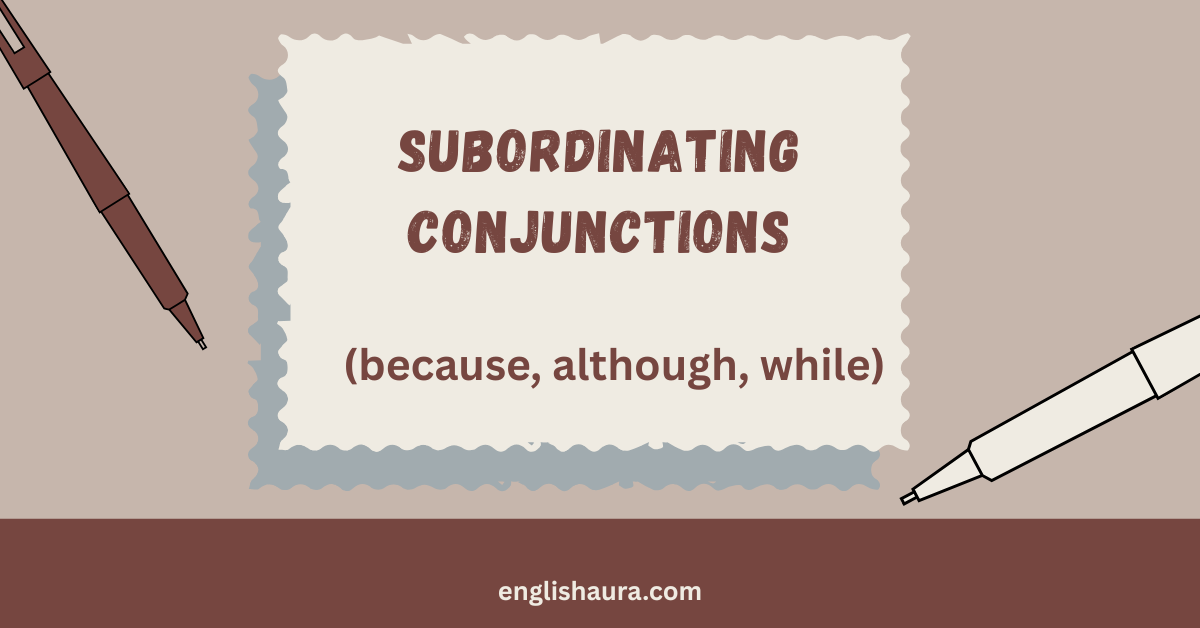
Subordinating conjunctions are words that connect a dependent clause (a clause that cannot stand alone) to an independent clause (a complete sentence).
They show reason, contrast, time, condition, purpose, or place. These include: because, although, while, since, if, unless, when, after, etc.
I was tired, and went to bed. Because I was late, so I missed the bus.
Because I was late, I missed the bus. OR I was late, so I missed the bus.
Although it was raining, but we went out.
Although it was raining, we went out. OR It was raining, but we went out.
Rule – 1: Never use “because” and “so” together — pick one, since they express the same cause-and-effect relationship.
Rule – 2: “Although” and “but” both signal contrast — using both together is redundant.
More natural examples:
- I stayed home because I had a fever.
- Although he was busy, he helped his sister.
- If you practice daily, your English will improve.
- I called you while I was on the bus.
Correlative Conjunctions
SIMPLE DEFINITION
Correlative conjunctions are pairs of words that work together to link balanced ideas in a sentence. Each part of the pair connects equally important sentence elements, such as words, phrases, or clauses.
They help make your writing clear, professional, and well-structured. These include: either…or, neither…nor, both…and, not only…but also
Either John or his friends is coming.
Either John or his friends are coming.
Rule: The verb agrees with the nearer subject. Since ‘friends‘ is plural, are is correct.
More learner-friendly examples:
- Either you start now, or you will be late.
- Neither the teacher nor the students were ready.
- She is both smart and hardworking.
Think of them as teamwork: one word can’t function without its pair.
Why Learners Struggle with Conjunctions:
Many students use conjunctions repetitively or incorrectly. The biggest problem is not the word itself, but choosing the wrong word for the relationship between ideas.
Here are a few common patterns:
- Overusing and instead of using but, so, or while.
- Using because as a full sentence fragment.
- Mixing ‘although‘ with ‘but‘ in the same sentence.
- Writing long, run-on sentences with too many ideas joined together.
Better versions:
- Weak: I want to improve and I practice and I read English and I watch videos.
- Better: I want to improve, so I practice every day and watch English videos.
- Weak: Because I was tired.
- Better: Because I was tired, I went to bed early.
- Weak: Although it was late, but I stayed.
- Better: Although it was late, I stayed.
Conjunction Comparison Table
| Conjunction | Meaning / Use | Example | Common mistake |
|---|---|---|---|
| and | Adds similar ideas | She studies and works. | Used instead of but or so. |
| but | Shows contrast | He is smart but lazy. | Forgotten in contrast sentences. |
| so | Shows result | It rained, so we stayed home. | Mixed with because. |
| because | Gives reason | We stayed home because it rained. | Used with so in one sentence. |
| although | Shows unexpected contrast | Although it rained, we went out. | Followed by but unnecessarily. |
Quiz Test — Solve It Yourself
FAQs: Simple Conjunctions Guide
Coordinating, subordinating, and correlative are the three basic types of conjunctions.
F – For, A – And, N – Nor, B – But, O – Or, Y – Yet, S – So.
And connects similar or additional ideas, while But shows contrast or an opposing idea in a sentence.
1. Use coordinating conjunctions for equal ideas.
2. Use subordinating conjunctions for dependent ideas.
3. Use correlative conjunctions for paired ideas.
Use and for addition, but for contrast, so for result, and because for reason.
Because although already shows contrast, so adding but creates unnecessary duplication.
Yes, but the clause should be complete. For example: Because I was late, I missed the bus.
Use one clear conjunction at a time, and make sure each sentence has the right punctuation and structure.
Leave a Reply