
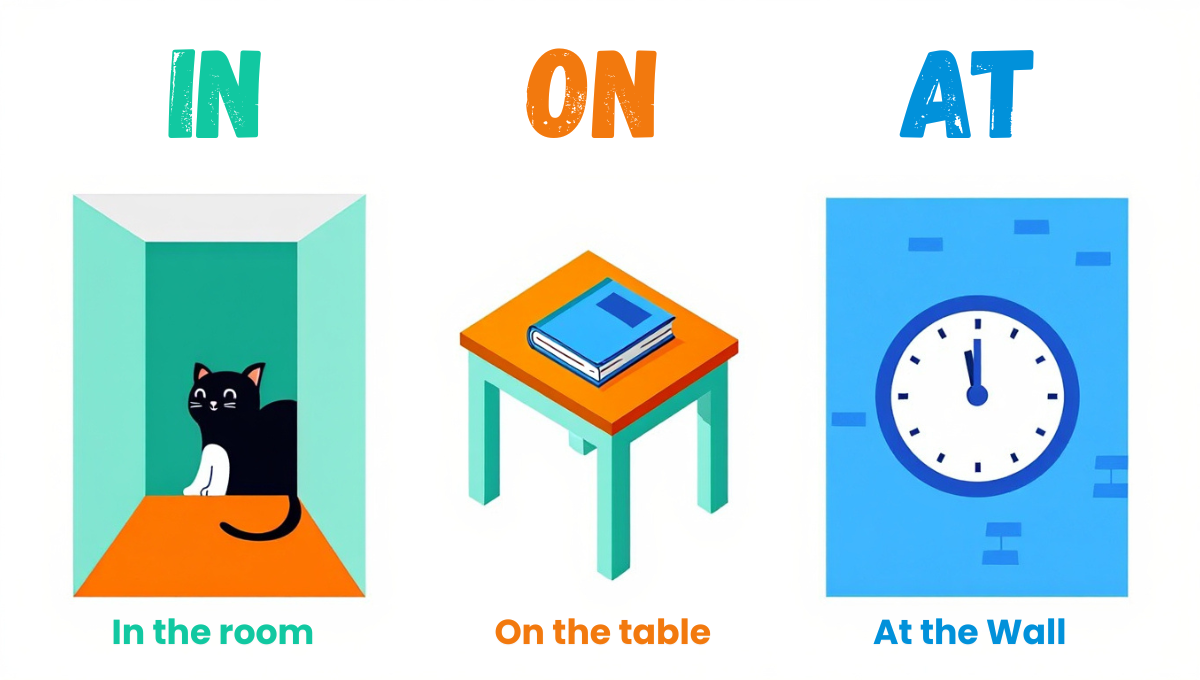
Many learners know prepositions like in, on, and at, but still choose the wrong one when they write messages, emails, or exam answers.
You might say “I am agree in this” instead of “agree with,” or write “since two years” instead of “for two years,” without knowing exactly why it sounds wrong. That gap between knowing the words and using them correctly is where most preposition mistakes happen.
Prepositions look small, but they confuse because the same word can work differently in time, place, and fixed phrases. “On” can mean a surface (“on the table”), a day (“on Monday”), or part of a fixed expression (“on time”) — and nothing about the word itself tells you which one applies.
This guide is built around that problem. Instead of just listing rules, it shows you where learners actually go wrong, why the correct choice makes sense, and how to use prepositions the way they naturally appear in daily life.
What Is a Preposition for Beginners?
SIMPLE DEFINITION
A preposition is a small word that links nouns or pronouns to other words in a sentence — usually to show time, place, or direction. (E.g, in, on, at, by, for, with, from, to, over, under, about, between, during, before, after, through)
It is one of the important Parts of Speech in English.
Example Sentences:
- The keys are on the table. (place)
- We arrived at 5 PM. (time)
- This gift is for you. (relationship)
- He walked through the park. (Movement)
- She is in the room. (place or position)
The Most Useful Prepositions to Learn First
Instead of memorising a long list on day one, start with the prepositions that show up constantly in real speech and writing: in, on, at, to, for, from, into, onto, by, and with. Once these feel natural, the rest become much easier to pick up.
- Place: where something is (in, on, at, under, between).
- Time: when something happens (at, on, in, during).
- Direction / movement: where something moves (to, into, onto, from).
- Fixed phrases & common uses (good at, interested in, married to).
1. Prepositions of Place (Simple Rules + Examples)
SIMPLE DEFINITION
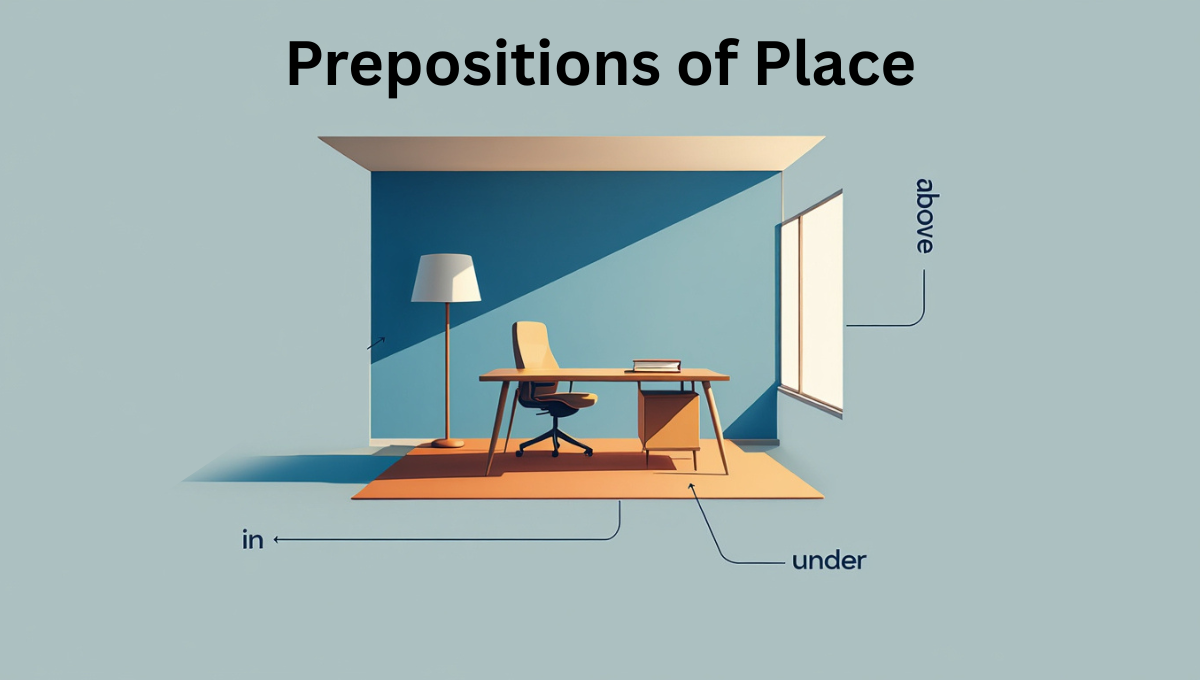
These prepositions tell us ‘where something is located‘. Simply, these show location. They answer questions like Where is it? Or where did it happen? (E.g., in, on, at, under, above, between, next to, behind)
Simple Rules & Examples:
- In Enclosed spaces, container, or area: Liya is in the room.
- On Surfaces: The book is on the shelf.
- At A point or specific place: He is at the bus stop.
- Under Something is below another thing: The remote is under the table.
- Above Something higher than another thing: The lamp hangs above the table.
2. Prepositions of Time (Simple Rules + Examples)
SIMPLE DEFINITION
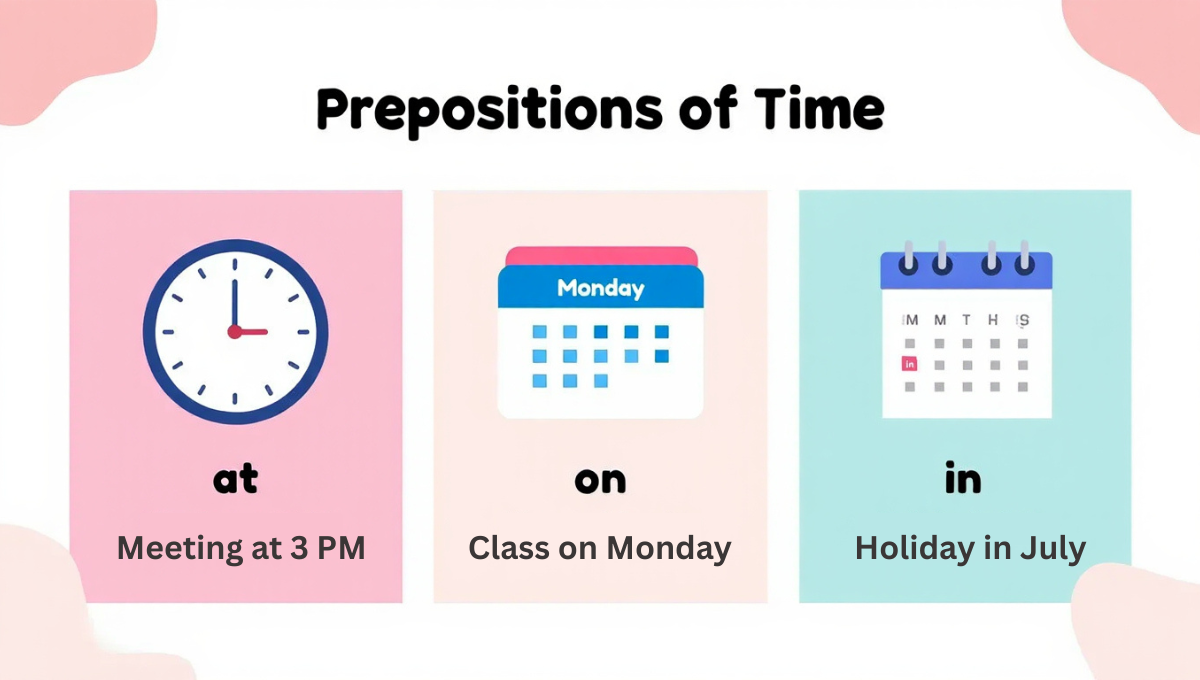
They tell us when something happens. They answer questions like When did it happen? (E.g., at, on, in, during, before, after, by, since, for)
Simple Rules & Examples:
- At Exact time or a few fixed expressions: The meeting is at 5 PM.
- On A specific day or date: We are meeting on Monday.
- In Months,years or long periods: Zain joined in July, in 2025.
- By Marking a deadline: We will finish the task by Friday.
- Since Fixed starting point in time — always answers “from when?”: Saba has been working here since 2022.
3. Prepositions of Direction (Simple Rules + Examples)
SIMPLE DEFINITION
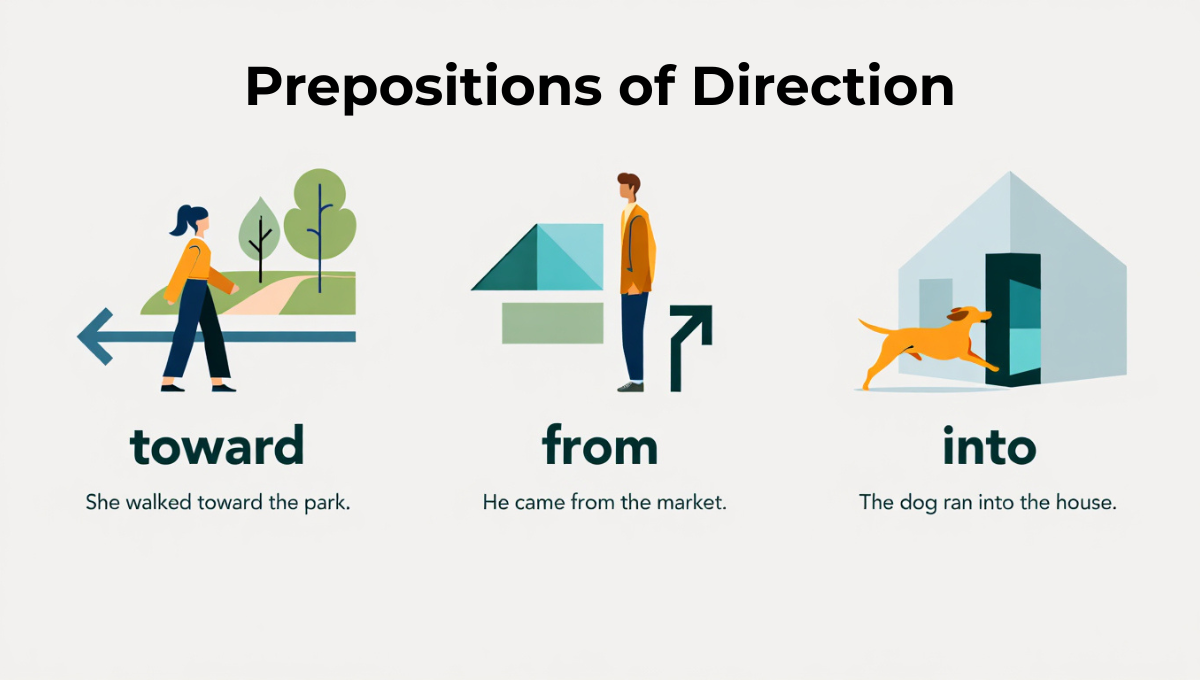
These answer “Where to?” or “Where from?” — they describe motion, direction, or movement, not a fixed position. (E.g., to, from, into, onto, through, toward, out of)
Simple Rules & Examples:
- to direction or movement toward: She walks to school.
- into movement inside (entering a space): Sara went into the room.
- Onto movement ending on a surface: Lily jumped onto the stage.
- Through passes in and out: He runs through the park.
- Towards in the direction of: The bus is heading toward the city.
Additional Notes for Beginners
- Many prepositions can overlap in meaning. For example, ‘on‘ and ‘onto‘ both relate to surfaces, but onto implies movement.
- Pairing prepositions with verbs and nouns forms prepositional phrases (e.g., “walk to the park,” “interested in music“).
Common Fixed Phrases
Some prepositions don’t follow a logical rule at all — they are simply fixed with certain words, and learners have to absorb them as a pair.
- interested in music
- afraid of spiders
- married to someone (not “married with”)
- good at cooking
- depends on mood
Comparison Table — Most Confused Pairs
| Pair | Difference | Example |
| in / on / at | in = inside a space or period; on = a surface or specific day; at = an exact point. | in the box / on the shelf / at the door |
| to / for | to = direction or a specific person/place; for = purpose, duration, or benefit. | go to the market / a gift for you |
| into / onto | into = movement to the inside; onto = movement ending on top of a surface. | walk into the shop / jump onto the bed |
| since / for | since = a fixed starting point in time; for = a length of time. | since Monday / for three days |
| by / with | by = the doer of an action or a deadline; with = accompaniment or a tool used. | written by her / cut with a knife |
Wrong vs Correct — Common Learner Mistakes
- She is married with him.
- She is married to him.
“Married” pairs with “to,” a fixed phrase with no logical reason.
- I have been here since two years.
- I have been here for two years.
“Since” needs a starting point (since 2022); “for” needs a duration (for two years).
- He entered into the room.
- He entered the room.
“Enter” already implies movement in — “into” is unnecessary here.
- The gift is for from my brother.
- The gift is from my brother.
“From” already shows the source; “for” is not needed alongside it.
- I will call you in the evening at 5.
- I will call you at 5 in the evening.
The exact time (“at 5”) usually comes before the broader period (“in the evening”).
- I will go in the market.
- I will go to the market.
Use to for direction toward a place.
Preposition Confusion in Student Writing
In essays, emails, and exam answers, a single wrong preposition — “good in maths” instead of “good at maths,” or “depend of” instead of “depend on” — can make an otherwise strong sentence feel off, even when the meaning is clear.
This happens because prepositions rarely translate one-to-one between languages, so learners often carry over their first language’s logic instead of English’s own pattern.
Mistakes Pakistani Learners Often Make
- “Discuss about” instead of “discuss” — the verb already means “talk about.”
- “Since two years” instead of “for two years” — since marks a starting point, not a duration.
- “Reply back” instead of “reply” — no preposition needed.
- “Married with” instead of “married to” — a fixed phrase used incorrectly.
- “Comprised of” instead of “comprises” — a common mix-up in formal writing.
Many of these mistakes come from translating Urdu sentence logic directly into English — for instance, “discuss” already implies “about,” so adding it is redundant. The fix isn’t memorizing every exception; it’s noticing that verbs like discuss, enter, and reach already contain the idea of direction or topic, so no preposition follows.
What Is a Prepositional Phrase?
SIMPLE DEFINITION
A prepositional phrase is a group of words starting with a preposition and ending with a noun or pronoun. It gives extra information about time, place, direction, cause, or manner.
- During the meeting, he took notes carefully.
- The dog ran through the garden.
Quick Recap
- Prepositions connect nouns and pronouns to the rest of the sentence — usually showing place, time, or direction.
- Start with the ten most useful prepositions (in, on, at, to, for, from, into, onto, by, with) before expanding the list.
- Most mistakes come from fixed phrases (married to, good at) or from translating another language’s logic directly into English.
- Comparing confusing pairs side by side — in/on/at, to/for, since/for — makes the difference easier to remember than a definition alone.
- Practice with everyday sentences, not just textbook lines, so the choice becomes automatic.
Quiz Test — Solve It Yourself
FAQs About Prepositions
The four most useful categories to start with are place (in, on, at), time (at, on, in), direction (to, into, onto), and fixed phrases (married to, good at) that don’t follow a strict rule.
“At” points to an exact spot or time, “on” refers to a surface or a specific day, and “in” refers to an enclosed space or a longer period of time.
“Since 2020” is correct, because “since” is used with a fixed starting point. “For” would be used with a length of time, such as “for two years.”
Focus on learning prepositions in phrases rather than in isolation — for example, “married to” or “good at” as whole units — and review wrong-vs-correct examples regularly, since contrast tends to stick better than rules alone.
“During the meeting” and “through the garden” are both prepositional phrases — a preposition followed by a noun that adds detail about time or place.
Leave a Reply