

In English grammar, every complete sentence has two main parts:
- A Subject (the Who/What)
- A Predicate (the What Happens)
They work in partnership to form a complete thought.
Once you discover how to identify the subject and predicate in a sentence, understanding sentence structure becomes much easier, and your writing becomes clearer.
Understanding Subject and Predicate
The subject tells you who or what the sentence is about. It can be a noun, a pronoun, or a noun phrase.
Examples:
- Ali plays cricket. → Ali is the subject.
- The cat is sleeping. → The cat is the subject.
- Honesty is important. → Honesty is the subject.
The Predicate is the part of the sentence that tells something about the subject. It includes the verb and everything that gives information about what the subject does, has, or is.
Examples:
- Ali plays cricket. → plays cricket is the predicate.
- The cat is sleeping. → is sleeping is the predicate.
- Honesty is important. → is important is the predicate.
In each sentence, the subject answers “who or what?” and the predicate answers “does what?” That is the heart of the subject and predicate in grammar.
Simple Formula
A sentence is usually made of: Subject + Predicate = Complete Sentence
Examples:
| Sentence | Subject | Predicate |
|---|---|---|
| Birds fly. | Birds | fly |
| Sarah reads books. | Sarah | reads books |
| The children are happy. | The children | are happy |
| My brother bought a new car. | My brother | bought a new car |
For more background on these core pillars, feel free to explore our comprehensive Grammar Category guides.

How to Identify Subject and Predicate in a Sentence
If you want a simple method, use this three-step trick every time.
Step 1: Find the Action Anchor (The Verb)
Before searching for the noun, scan the sentence for the main verb. Look for an action verb (runs, eats) or a state-of-being verb (is, was, were). The verb usually marks the beginning of the predicate.
In the sentence The cat sleeps on the sofa, sleeps is the main verb.
Step 2: Ask “Who” or “What” is Doing the Action
Now ask: who or what is doing this action? The answer gives you the subject.
Examples:
- The cat sleeps. → Who sleeps? The cat.
- They play football. → Who plays? They.
- My sister is tired. → Who is tired? My sister.
Step 3: Identify the Complete Predicate
The predicate is the verb plus all the information attached to it.
Examples:
- The cat sleeps on the sofa.
- Subject: The cat
- Predicate: sleeps on the sofa
- They play football every evening.
- Subject: They
- Predicate: play football every evening
Remember, the predicate is not just the verb. It includes the verb and all the words that tell what the subject does, has, or is. These words may include objects, complements, and other details.
Simple vs complete subject and predicate
Subjects and predicates can be either simple or complete. A simple subject or predicate contains only the main word, while a complete subject or predicate includes all the words that go with it.
| Type | Meaning | Example |
|---|---|---|
| Simple subject | The main noun or pronoun | dog |
| Complete subject | The subject and all its describing words | the small dog |
| Simple predicate | The main verb | runs |
| Complete predicate | The verb and all the words that follow it | runs to the park every morning |
Example
“The enthusiastic young student wrote an incredible short story.“
- Simple subject: student
- Complete subject: The enthusiastic young student
- Simple predicate: wrote
- Complete predicate: wrote an incredible short story
Understanding this difference makes it easier to analyze sentences and improve your grammar and writing skills.
Compound Subject and Compound Predicate
Once you understand simple subjects and predicates, you can move on to compound forms.
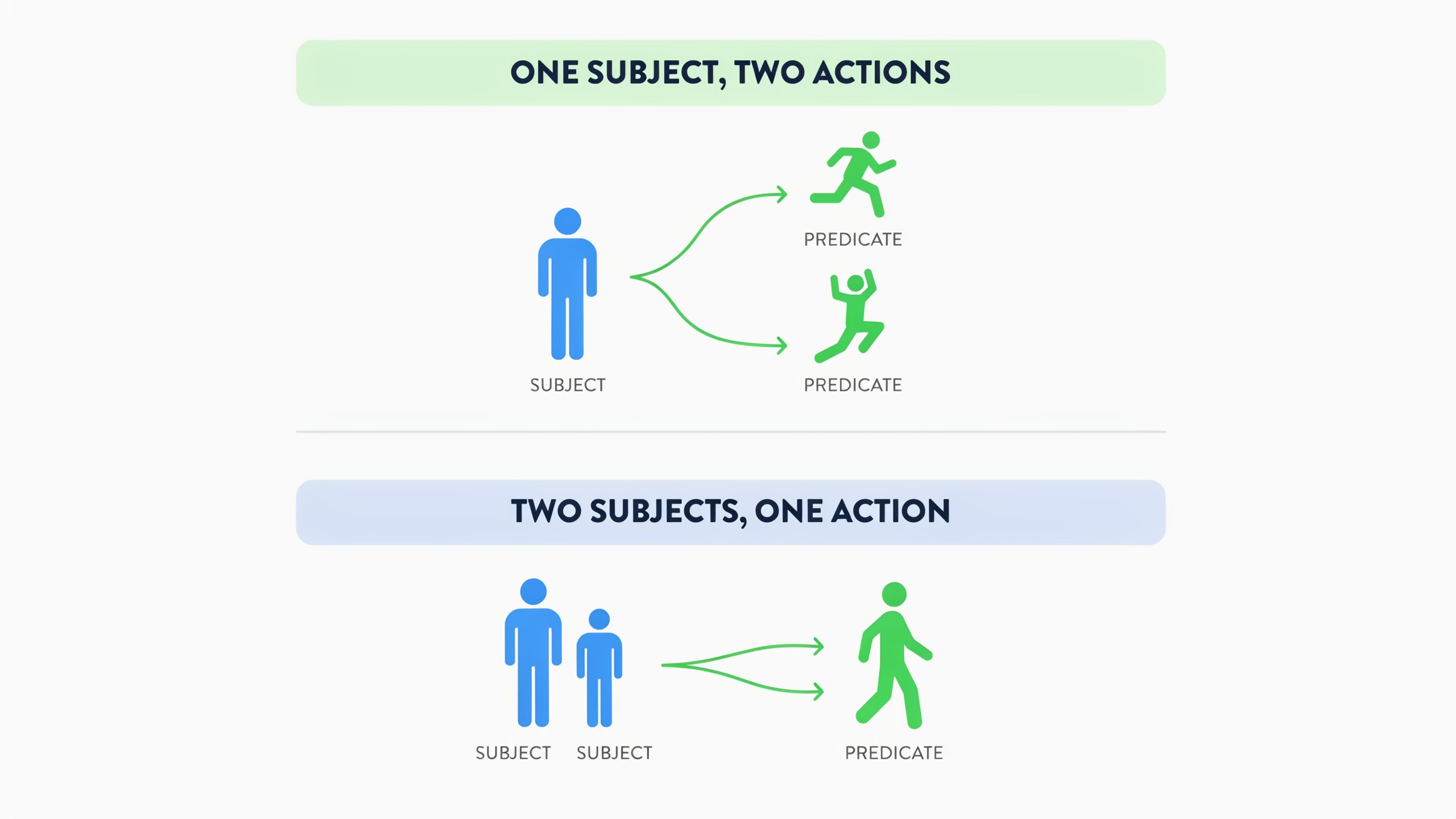
A compound subject has two or more subjects that share the same verb.
Example:
Tom and Jerry play chess.
- Compound subject: Tom and Jerry
- Predicate: play chess
A compound predicate has one subject performing two or more actions.
Example:
She sings and dances.
- Subject: She
- Compound predicate: sings and dances
A sentence can also have both a compound subject and a compound predicate.
Example:
The teacher and the student opened the laptop and typed a chapter.
- Compound subject: The teacher and the student
- Compound predicate: opened the laptop and typed a chapter
Even in longer sentences, the rule stays the same: first find who or what the sentence is about, then identify what the subject does, has, or is.
Three Tricky Sentence Types
Most sentences follow the usual subject-then-predicate pattern, but some sentence types can confuse learners.
Imperative sentences (Commands)
In commands, the subject is not written, but it is still there. Examples:
- Close the door.
- Sit down.
- Be careful.
The subject is understood as you, so these sentences still have both a subject and a predicate.
Sentences with there or here
- There is a problem.
- There are three books on the desk.
- Here are your keys.
In these sentences, ‘there and here‘ are not the real subjects. The real subject comes later.
- There are three books on the desk.
- Here are your keys.
Long Sentences with Extra Details
Examples:
- The dog in the garden with the red collar barked loudly.
- The box of old pens sits on the table.
Extra words can be distracting, but the main subject and predicate stay the same.
- Subject: dog
- Predicate: barked loudly
- Subject: box
- Predicate: sits on the table
Why Does This Matter?
Understanding subjects and predicates helps you:
- write clearer sentences.
- avoid sentence fragments and run-on sentences.
- combine ideas more effectively.
- control sentence length and rhythm.
- make your writing smoother and easier to understand.
Grammar is not just about rules. It is a tool that helps you express your ideas more clearly and confidently.
Subject and Predicate Exercises for Students
Try the following exercises. First, identify the subject, then identify the predicate.
- The boy reads a comic book.
- My mother cooks dinner.
- The stars shine brightly.
- Tom and Sana are studying.
- There is a cat on the roof.
Answers
- Subject: The boy | Predicate: reads a comic book
- Subject: My mother | Predicate: cooks dinner
- Subject: The stars | Predicate: shine brightly
- Subject: Tom and Sana | Predicate: are studying
- Subject: cat | Predicate: is on the roof
If you can do these correctly, you are already improving your sentence control.
Learning how to identify the subject and predicate in a sentence makes grammar much easier. Every complete sentence has these two parts, and once you can recognize them, understanding sentence structure becomes simpler.
Keep practicing with both simple and longer sentences. With time, finding subjects and predicates will become natural, helping you write clearer and more effective sentences.
For deeper dives into sentence architecture, check out trusted resources like the Purdue University Online Writing Lab (OWL). For excellent fundamental grammar guides, BYJU’S offers fantastic additional support.
FAQS: Subject and Predicate in a Sentence
A subject tells who or what the sentence is about, and a predicate tells what that subject does or is.
Example: The lazy dog slept on the rug.
First find the verb, then ask who or what is doing the action.
Everything after the subject, including the verb, is the predicate.
Predicates can be one word. They can be short, long, or even compound.
The simple subject is the main word naming the subject, and the simple predicate is the main verb.
Leave a Reply