
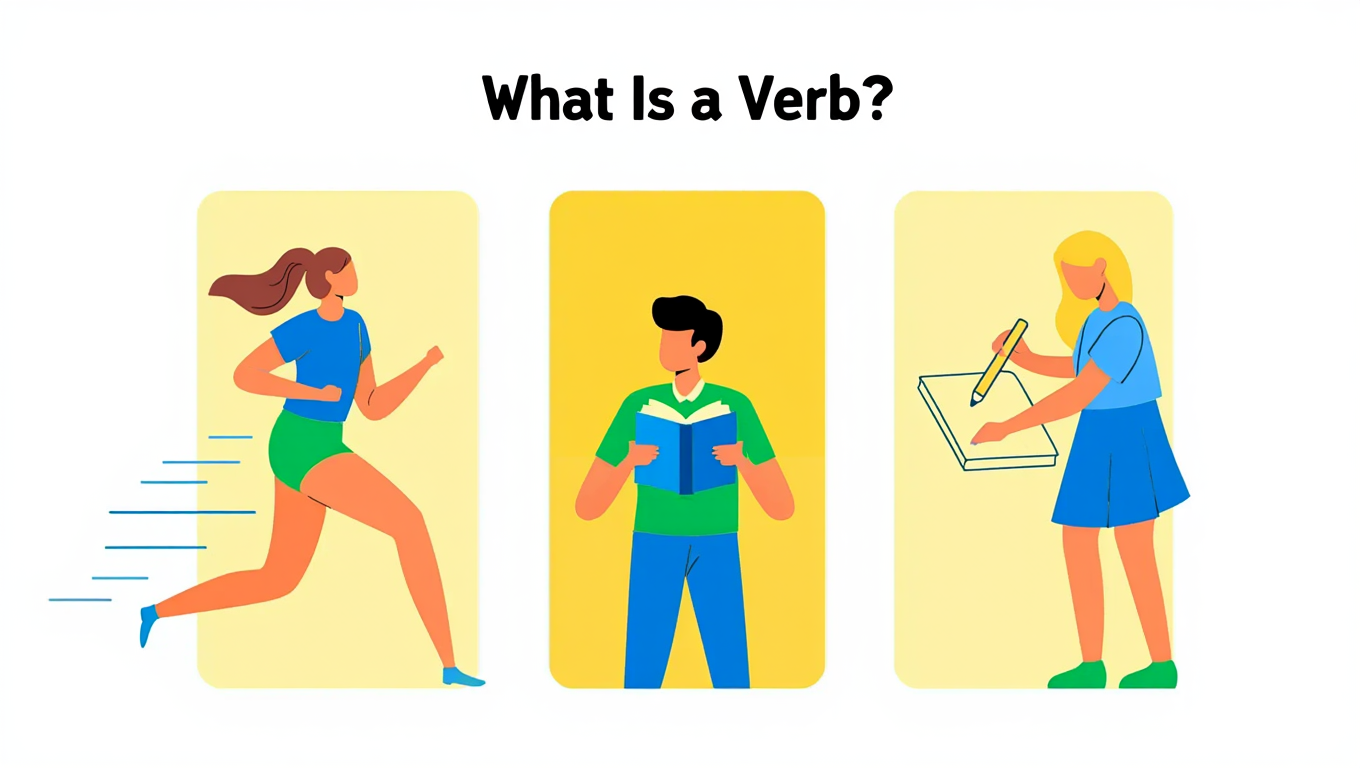
A sentence without a verb is like a car without an engine. It cannot move. If you are learning English, understanding ‘what is a verb’ is the key to making sentences work. A verb powers every story we tell.
This guide breaks down verb definition and types of verbs, with easy examples you can relate to. Let’s make grammar fun and simple.
Verb Definition in Simple Terms
A verb is a word that tells us what the subject does, experiences, or becomes. So, what do verbs do in a sentence? Verbs describe action, occurrences, or states of being.
In grammar, verbs belong to the group of parts of speech that help express time, attitude, and certainty. Examples include: run, write, think, feel, eat, grow, etc
- Kids run to school eagerly.
- She feels happy after the gym.
- Plants grow tall in the rain.
Here are the key Traits of Verbs:
- Check actions and events: ‘Birds fly south.’
- Reveal state of being: ‘She feels tired.’
- Express tense mood and voice (past/future, questions/commands, active/passive): ‘She walks‘ (present active) shifts to ‘Did she walk?’ (past question).
- Can change forms for grammar flow: ‘Run’ becomes ‘ran’ or ‘running’ to fit stories smoothly.
Core Types of Verbs in English Grammar
Many learners ask how many types of verbs there are. The answer depends on how deeply you study grammar. Below is a clear list of English verb types with easy examples for learners.
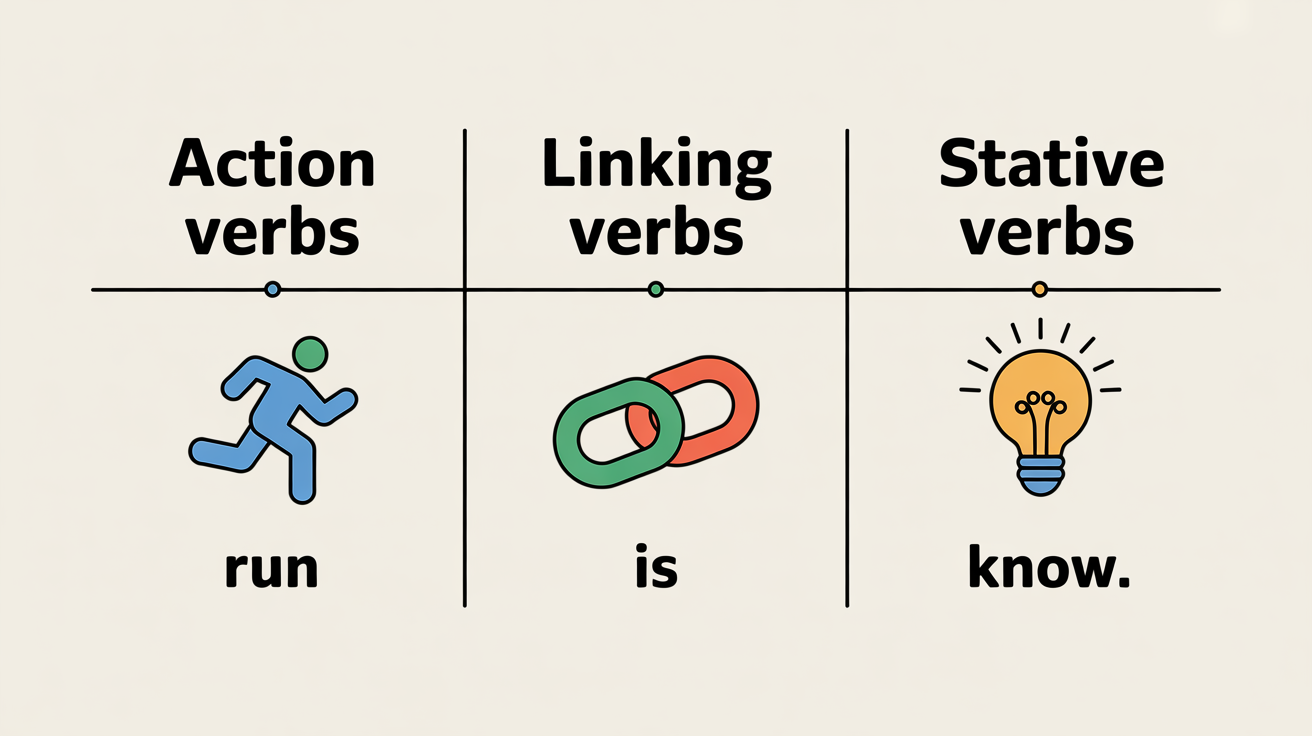
Action Verbs
Action verbs, also called dynamic verbs, show physical or mental actions. They describe what someone or something does. They often answer “what is happening?” in a sentence. Examples include: write, cook, jump, sing
Action verbs can show:
- Physical actions (running, eating)
- Mental actions (thinking, deciding)
Example Sentences:
- She writes poems at night.
- Frogs jump over puddles.
- Birds sing at dawn.
Next, let’s see verbs that don’t show action but instead link the subject to information.
Linking Verbs
Linking verbs, or copular verbs, do not show action. Instead, they connect the subject to more information about it. This information usually describes or identifies the subject.
A linking verb links the subject to:
Most linking verbs are forms of “to be” (is, am, are, was, were, being, been), but some verbs, like seem or feel, can also act as linking verbs. Examples include: is, am, are, was, seem, feel, become, appear
- The tea is hot.
- The weather was cold yesterday.
- Cotton feels soft.
- Stars appear bright tonight.
Finally, let’s explore verbs that describe states of being or mental conditions.
Stative Verbs (State of Being)
Many learners ask, Can verbs show a state of being? Yes, stative verbs do not show physical action. Instead, they describe thoughts, feelings, emotions, senses, or mental states. These verbs tell us what someone is or feels, not what they do.
Point to Remember:
Most state-of-being verbs are not usually used in continuous (-ing) forms, because states do not change moment by moment.
Regular vs Irregular Verbs
Regular Verbs form their past tense and past participle by adding -ed or -d to the base form.
- Walk → walked → walked
- I walked to school yesterday.
- Play → played → played
- She played the piano beautifully.
- Talk → talked → talked
- We talked for hours last night.
Alternatively, Irregular Verbs do not follow the -ed rule for past tense and past participle. Their forms change irregularly and must be memorized.
- Go → went → gone
- She went to the market yesterday.
- Eat → ate → eaten
- I have eaten all the cookies.
- See → saw → seen
- We saw a beautiful bird.
Regular Verbs Table
| Base | Past | Past Participle |
|---|---|---|
| walk | walked | walked |
| talk | talked | talked |
| play | played | played |
| jump | jumped | jumped |
| cook | cooked | cooked |
Irregular Verbs Table
| Base | Past | Past Participle |
|---|---|---|
| go | went | gone |
| eat | ate | eaten |
| see | saw | seen |
| run | ran | run |
| sing | sang | sung |
Transitive and Intransitive Verbs
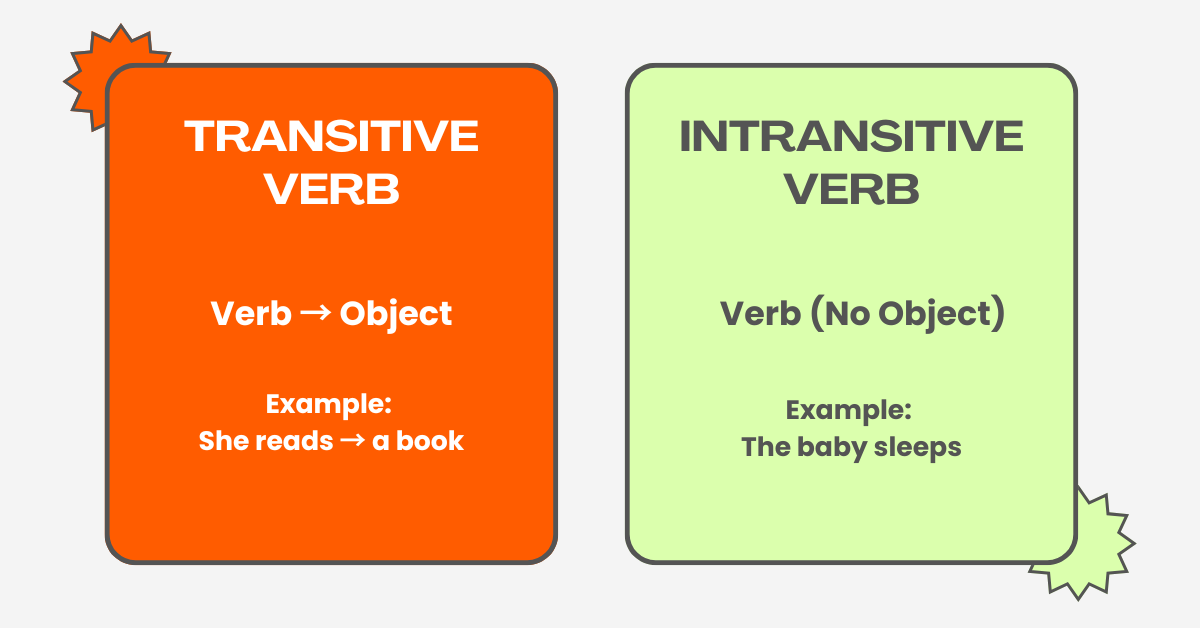
Transitive verbs require a direct object to complete their meaning.
- Buy: They buy groceries.
- Kick: The boy kicks the ball.
- Read: I read a book.
Intransitive verbs are verbs that don’t take objects. They do not act on anything; the action is complete by itself.
- Sleep: The baby sleeps peacefully.
- Laugh: We laugh together.
- Sit: Please sit down.
Supporting Verb Categories
Auxiliary Verbs
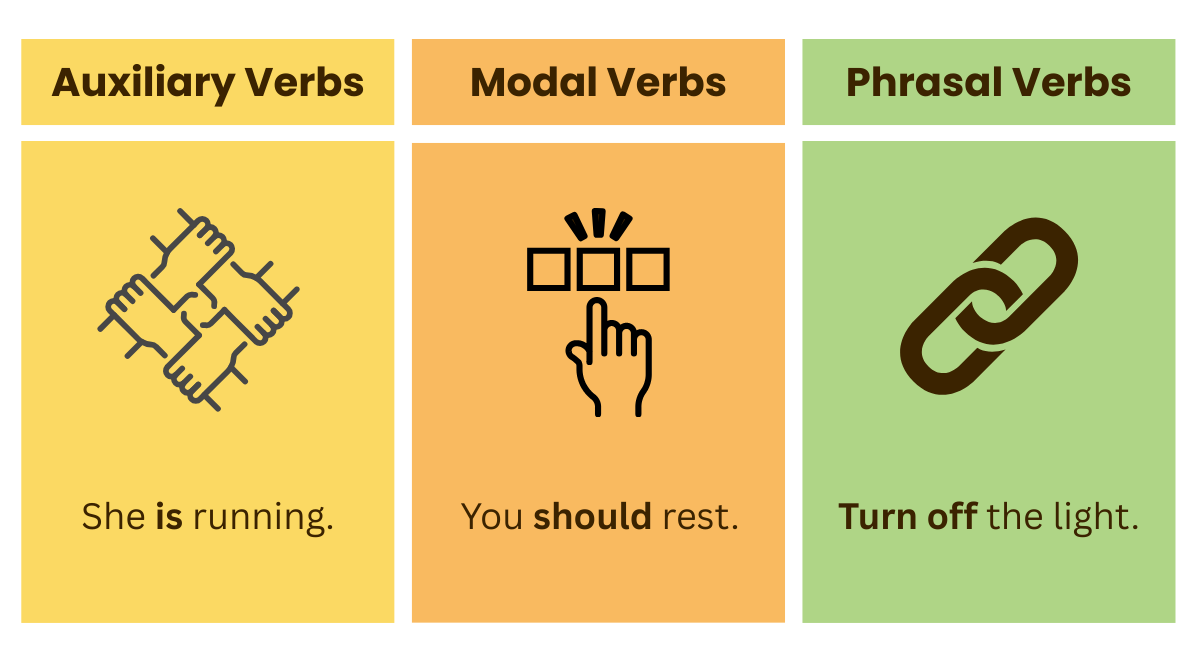
Auxiliary verbs support the main verb and help form tenses, questions, or negatives. The main verb carries core meaning; auxiliary verbs add tense, mood, or voice. Common auxiliary verbs include be, have, do, is, am, are, and will.
- Be (is): She is running.
- Have (has): They have eaten.
- Will (future): We will go.
Modal Verbs
Modal verbs show ability, permission, possibility, or necessity (can, could, may, might, must, shall, should, will, would). They pair with main verbs, no -s form.
- Can: I can swim.
- Should: You should drink water every day.
- May: May I leave?
Phrasal Verbs
Phrasal verbs combine a verb with a particle (preposition or adverb) and form a new meaning. Often, the meaning of a phrasal verb is different from the original verb alone. For example, “give up” doesn’t just mean give; it means stop trying. Examples include: Turn off, Pick up, Give up, Look after, Run out, Break down, Fill in, Hang out
- Turn off the fan. (Stop device)
- Never give up on dreams. (Quit)
- Look after your health. (Care for)
- Fill in the form. (Complete)
- Kids hang out at the park. (Spend time)
Why they matter:
- They can have multiple meanings depending on context.
- They make English sound natural.
- They are widely used in conversation, movies, and books.
Verb Forms & Tenses
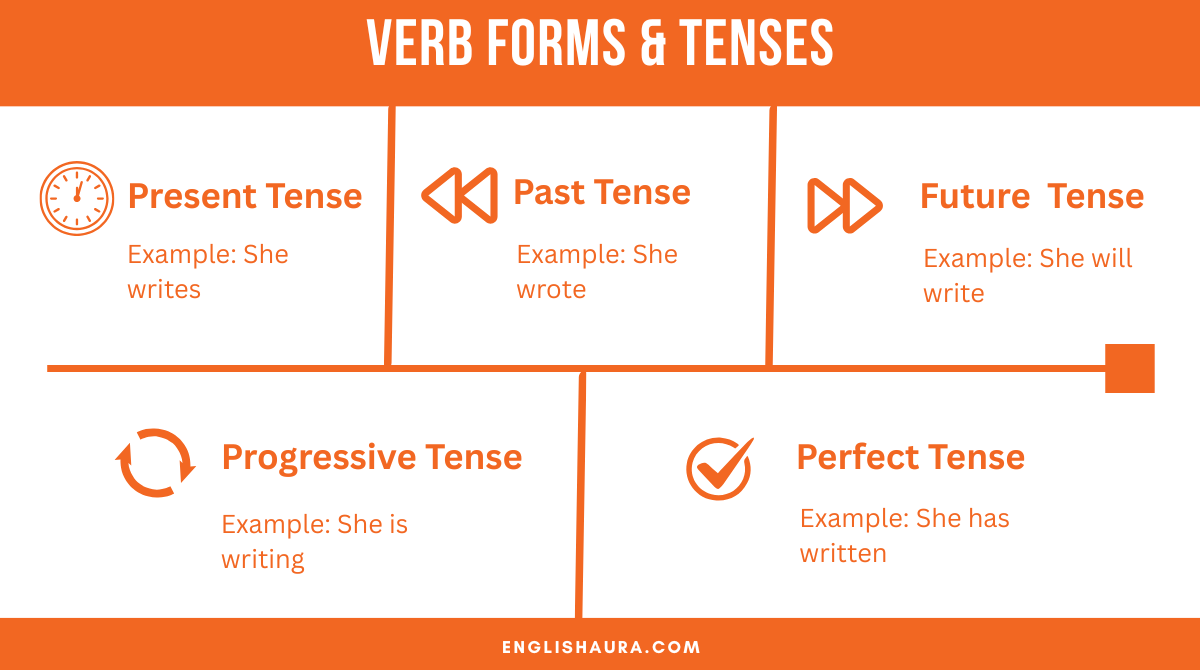
Verbs change with time. Understanding verb tenses and forms helps you express when an action happens. Learners often ask how verbs change with tense. English verbs can appear in present, past, and future forms, and also in progressive vs perfect tense.
Key Tenses
- Present (actions happening now or regularly) They walk to the park. (now)
- Past (actions that already happened): They walked to the park. (done)
- Future (actions that will happen): They will walk to the park. (later)
Progressive Tense (Shows Ongoing Actions)
- Present Progressive: She is writing a letter.
- Past Progressive: He was eating breakfast.
- Future Progressive: I will be going to school.
Perfect Tense (Shows completed actions)
- Present Perfect: She has written three emails today.
- Past Perfect: He had eaten before leaving.
- Future Perfect: I will have finished my homework by 5 PM.
Grammatical Mood & Subject-Verb Agreement
Grammatical mood adds flavor to verbs:
- Indicative → states facts: She writes a letter.
- Imperative → gives commands: Run!
- Subjunctive → expresses wishes or possibilities: If I were taller…
Correct sentence structure needs proper subject-verb agreement:
- Singular subject → singular verb: She runs fast.
- Plural subject → plural verb: They run every morning.
Now you clearly understand what a verb is, how it works, and why it matters. Knowing the types of verbs and practicing easy examples improves grammar faster than memorizing rules. If you master verbs, sentences start to feel alive. That is the real power of understanding verbs.
Leave a Reply