
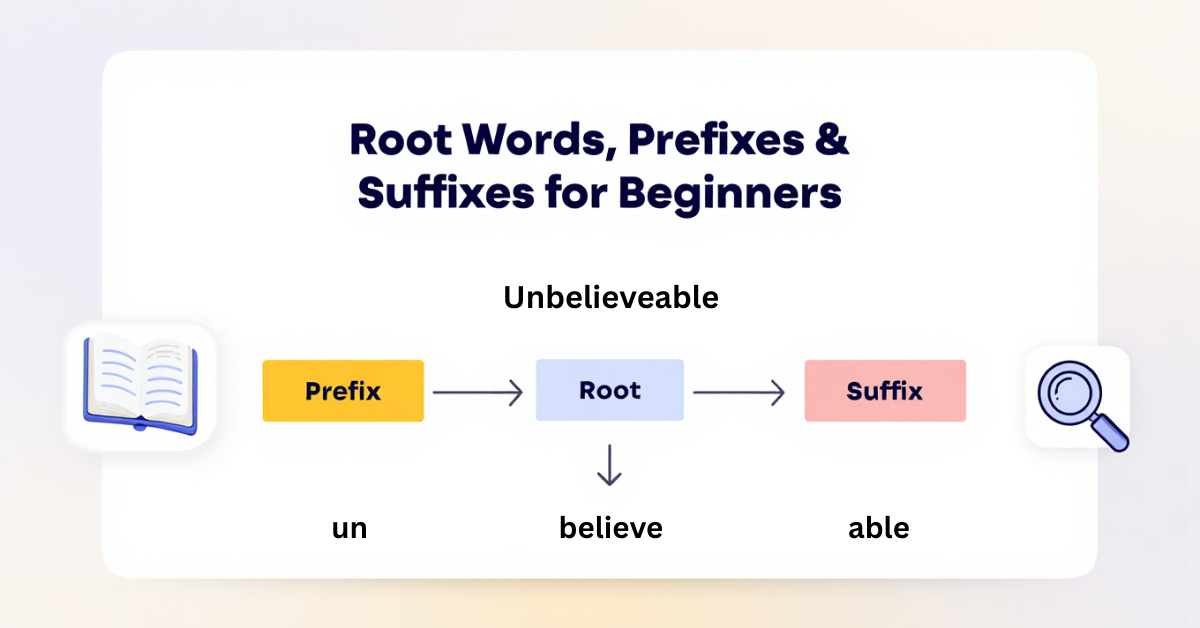
Imagine understanding hundreds of English words without memorizing each one. Root words, prefixes, & suffixes are your beginner vocabulary secret weapon.
Most beginners struggle with vocabulary because they randomly try to learn words. As a result, they forget quickly and feel stuck while reading or writing.
The smarter approach is to understand how words are built. That’s where root words, prefixes, and suffixes come in.
When you learn these building blocks, you can:
- Decode unfamiliar words
- Guess meanings instantly
- Improve reading and writing faster
In this guide, you’ll learn how root words for beginners, prefixes, and suffixes work together to form words—and how to use them as a system instead of memorization.
Core Concepts: Understanding Root Words
So, what exactly are root words in English vocabulary?
A root word is the main part of a word that carries its core meaning. Unlike base words, root words often cannot stand alone. Think of them as the foundation of a word.
Root Words vs Base Words (Important Difference)
Root Word
- Comes from Greek or Latin (See a Greek and Latin roots explanation.)
- Cannot stand alone
- Example: duc (lead) → conduct, deduce
Base Word
- A complete English word
- Can stand alone
- Example: play → replay, playful
This difference helps you understand how words are formed and expanded.
English word parts can be broken down into smaller word parts (prefix + root + suffix). This makes it easier to decode unfamiliar words that carry meaning.
Common Root Word Examples:
| Root Word | Meaning | Example |
|---|---|---|
| act | do /perform | action |
| port | carry | transport |
| dict | say | predict |
| struct | build | construct |
| form | shape/make | transform |
These roots appear in hundreds of English words.
Prefixes in Vocabulary: Simple Explanation
Now, let’s understand what prefixes are.
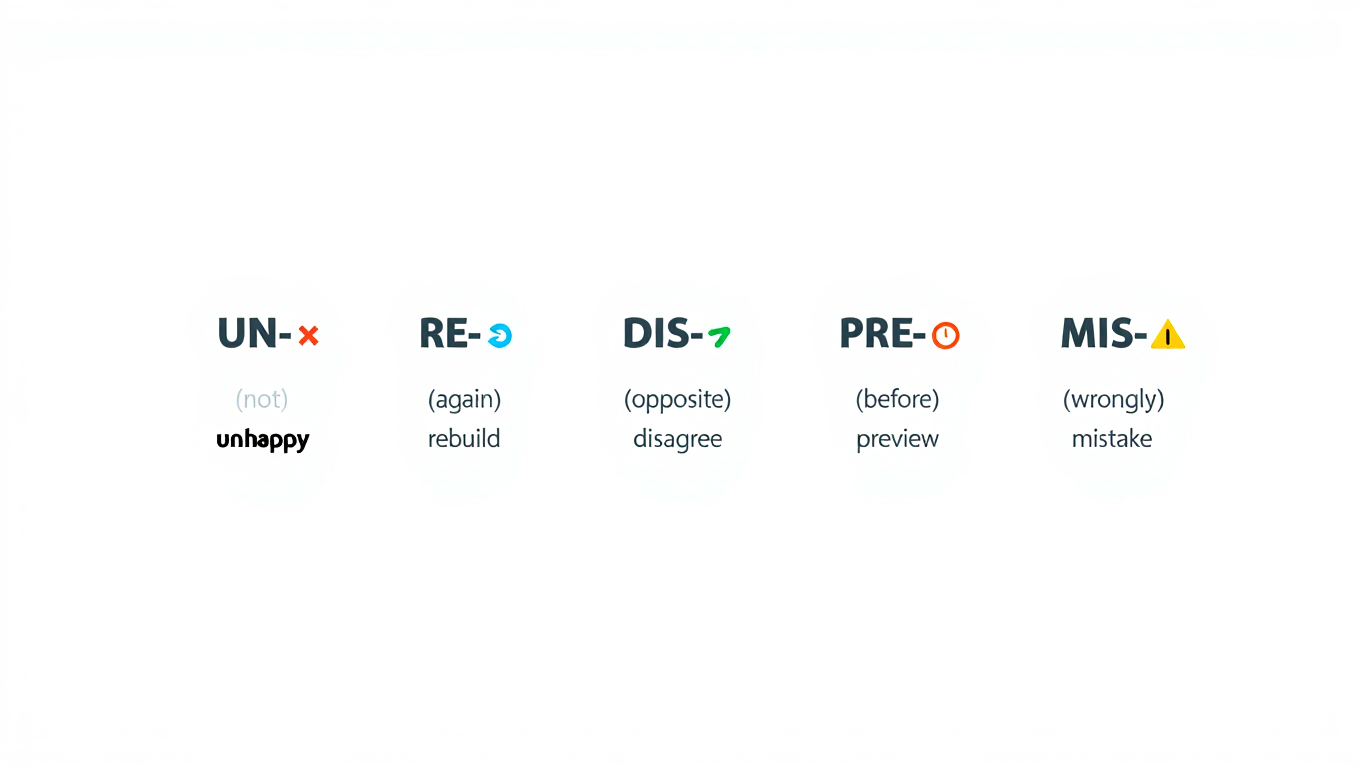
A prefix is added to the beginning of a root word. In simple words, a prefix is a word part that comes before a root word.
It does not stand alone. It only works when attached to another word. Example:
happy → un + happy = unhappy
How Prefixes Change Meaning
Prefixes change meaning in simple ways:
- They can make a word negative
- Show repetition
- Show the opposite idea
This is why they are powerful for decoding unfamiliar words.
Common Prefixes for Beginner Learners
See the following quick table to get a basic sense about prefixes:
| Prefix | Meaning | Example Word |
|---|---|---|
| un- | not | unhappy |
| re- | again | rewrite |
| dis- | opposite | disagree |
| in- | not | incorrect |
| im- | not | impossible |
| non- | not | nonstop |
| pre- | before | preview |
| mis- | wrong | misunderstand |
| over- | too much | overeat |
| under- | too little | underpaid |
Here are easy prefixes example sentences:
- She is unhappy today. (not happy)
- Please rewrite your answer. (write again)
- I disagree with that idea. (not agree)
Why Should Beginners Learn Prefixes?
Learning prefixes helps you:
- Understand new words faster
- Read without stopping
- Reduce dictionary dependency
You can also explore unclear sentence examples and fixes to improve clarity.
Suffixes in Vocabulary: Simple Explanation
Now let’s answer: what are suffixes?
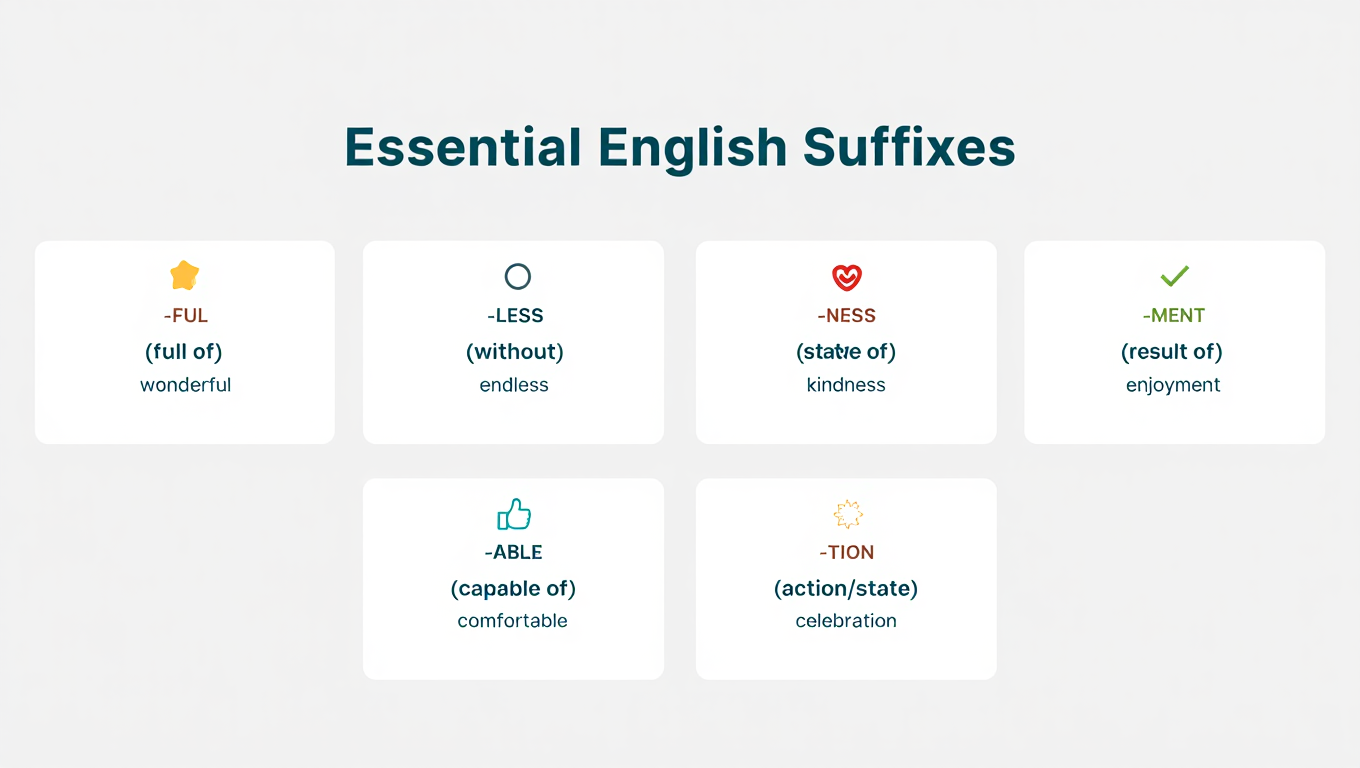
A suffix is a letter added to the end of a word to change its meaning, form, or function in a sentence. Example:
help → helpful
What Does a Suffix Do?
A suffix can:
- Change a word’s meaning
- Change a word’s grammatical role (noun, adjective, adverb)
- create new words
Think of a suffix like a clothing accessory. The root word remains the same, but the suffix changes how the word looks and works.
Common Suffixes for Beginners
Here is the list of suffixes to get an understanding of basic suffixes.
| Suffix | Meaning | Easy Example |
|---|---|---|
| -ful | full of | helpful |
| -less | without | hopeless |
| -ment | act or result | enjoyment |
| -ness | state or quality | kindness |
| -ly | in a certain way | quickly |
| -er | A person who does | teacher |
| -or | A person who does | actor |
| -able | can be | readable |
| -tion | act or process | education |
| -ist | a person who believes or practices | artist |
| -ous | full of | dangerous |
| -ive | having the quality of | active |
| -al | related to | natural |
| -y | having the quality of | rainy |
| -en | to make | widen |
Here are easy suffixes example sentences:
- She is very helpful. (full of help)
- He felt hopeless after losing the game. (without hope)
- Reading gives me great enjoyment. (act of enjoying)
You can also explore common confusing words in English to strengthen your understanding.
How Suffixes Help You Build New Words
By adding suffixes (and prefixes), you can create multiple words from one root:
- help → helpful → helpless
- kind → kindness
- quick → quickly
To improve variety in writing, use word swaps to fix repetitive writing.
Combining Root Words, Prefixes & Suffixes
This is where everything connects.
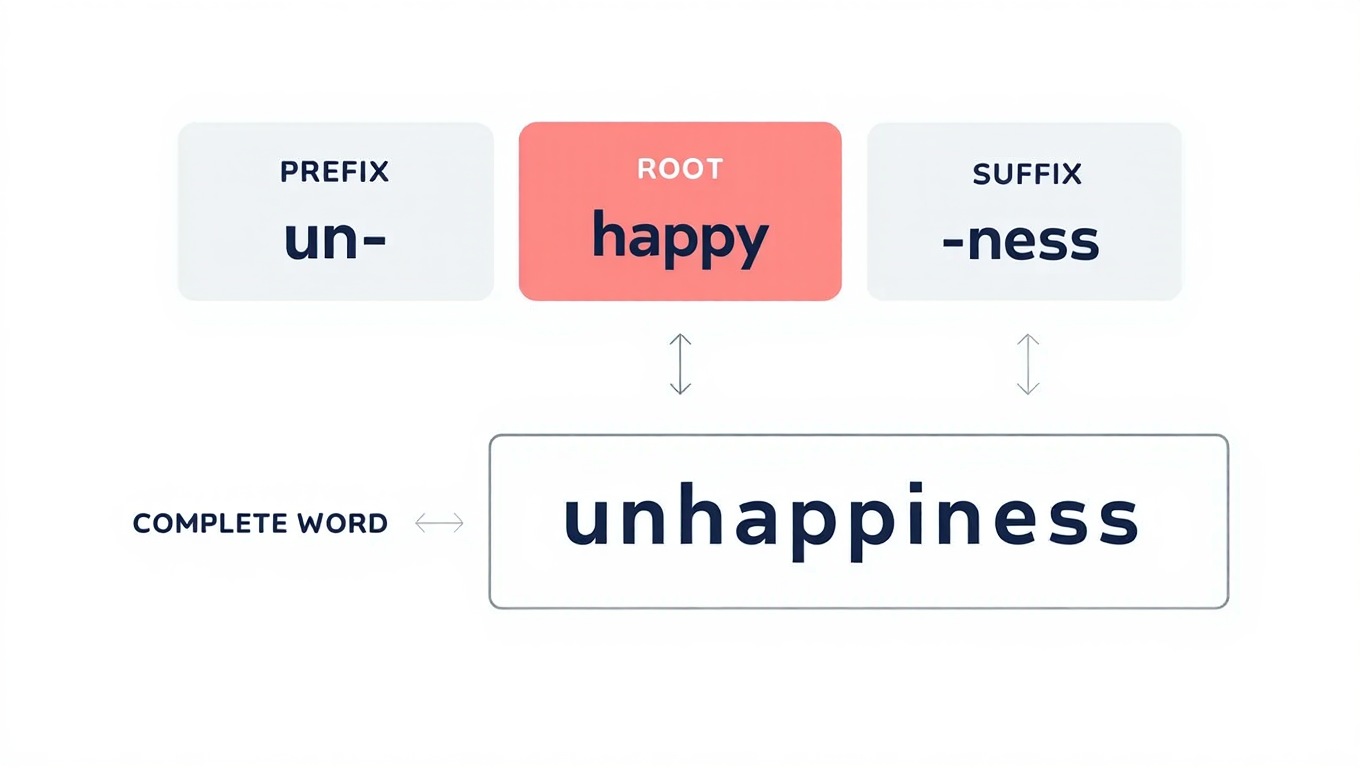
When you combine root words, prefixes, and suffixes, you stop memorizing and start understanding patterns.
How This Works (Simple Explanation)
- Prefix → changes meaning
- Base / Root word → core meaning
- Suffix → changes form or role
Think of a word like a building:
- Prefix = front door
- Root = main room
- Suffix = extra room
Together, they create a complete word.
Examples of Combined Words
| Prefix | Base Word (Root) | Suffix | New Word |
|---|---|---|---|
| un- | happy | -ness | unhappiness |
| re- | use | -able | reusable |
| im- | mortal | -ity | immortality |
| un- | success | -ful | unsuccessful |
| dis- | agree | -ment | disagreement |
| re- | write | -ing | rewriting |
| un- | kind | -ness | unkindness |
| pre- | view | -ed | previewed |
| mis- | understand | -ing | misunderstanding |
| in- | active | -ity | inactivity |
| over- | load | -ed | overloaded |
| under- | develop | -ment | underdevelopment |
| re- | appear | -ance | reappearance |
| non- | sense | -ical | nonsensical |
| dis- | connect | -ion | disconnection |
This method helps learners decode unfamiliar words effectively and also strengthens active and passive vocabulary skills.
Quick Tip for Beginners
If you learn these 15 suffixes, you can understand hundreds of words. This is far more effective than memorizing random vocabulary.
Learning root words, prefixes, and suffixes turns vocabulary into a system, not a memory task.
Instead of learning words randomly, you:
- recognize patterns
- understand meanings faster
- build long-term vocabulary
Start small. Practice daily. And gradually, you’ll notice that even difficult words become easier to understand.
You can also read why your essay sounds confusing to improve clarity further.
FAQs: Root Words, Prefixes & Suffixes
Root words are the core part of a word that gives it its basic meaning. For example, “act” means to do, as in action or react.
A root word may not stand alone (like struct), while a base word can (like help).
Prefixes add meaning to the start of a word. Example: un- + happy = unhappy.
Common suffixes: -ful (helpful), -less (hopeless), -ness (kindness), -ment (enjoyment), -ly (quickly).
Break words into prefix + root + suffix, use flashcards, practice exercises, and notice word families.
Leave a Reply