

Adverbs are one of the most useful parts of speech in English because they add detail, clarity, and meaning to sentences. They also help us explain how, when, where, or to what extent something happens, making communication more precise.
In this guide, you will learn ‘what are adverbs in simple words‘ using clear definitions, practical examples, and easy-to-follow explanations.
Definition of an Adverb
An adverb is a word that adds more detail. It can modify a verb, an adjective, or even another adverb, making your sentences richer and more descriptive.
Think of adverbs as helpers. They don’t usually stand alone. Moreover, they add flavor to action and description.
Common examples include: Quickly, slowly, loudly, now, soon, yesterday, here, there, often, too, very, almost, etc.
- She spoke softly.
- The cat is here.
- It’s very hot.
Types of Adverbs with Examples
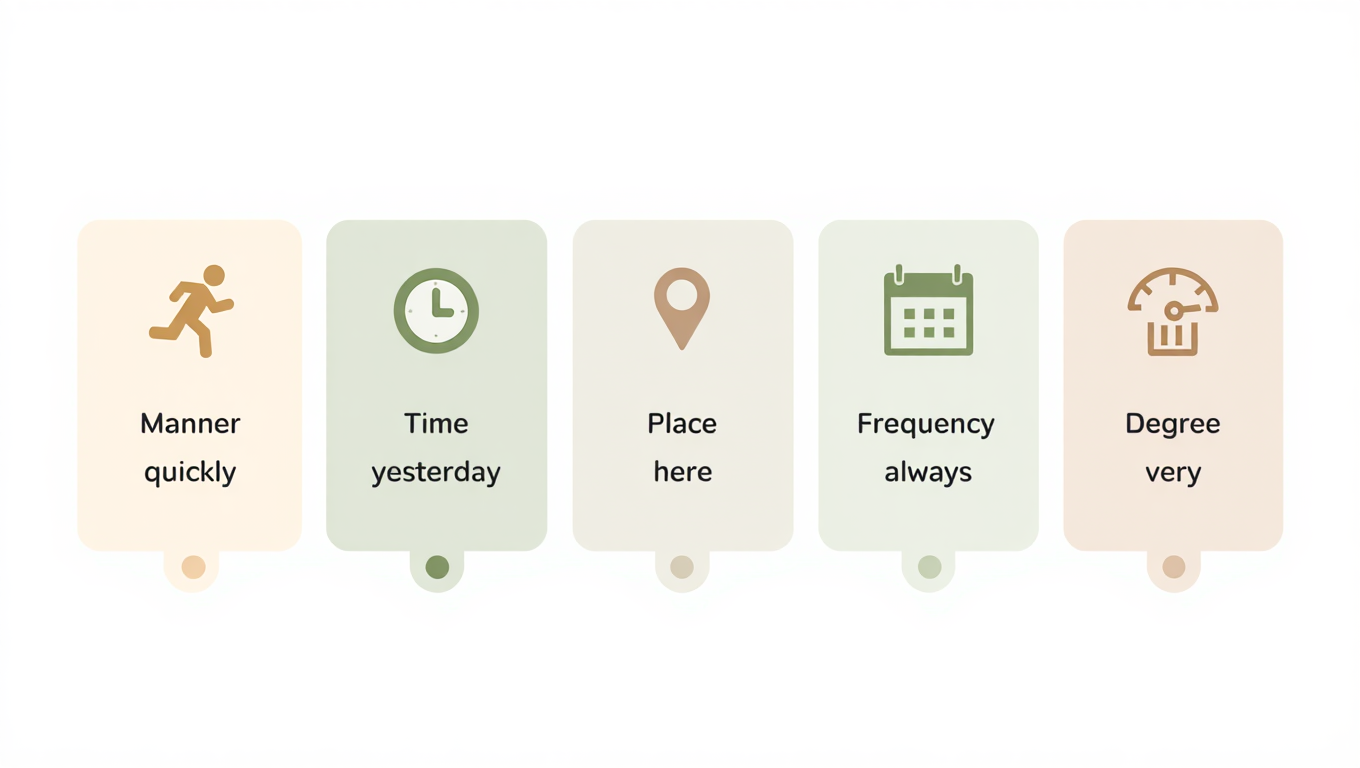
There are several types of adverbs; however, the most common are manner, time, place, frequency, and degree. Each type serves a unique function and helps make your sentences more precise.
Adverb of Manner: How Something Happens
An adverb of manner describes how an action happens. It tells about ‘the way something is done‘.
They are formed by adding –ly to adjectives. For example, slow becomes slowly, and careful becomes carefully.
However, not all manner adverbs end in –ly. Words like fast, well, and hard are also adverbs of manner, even though they do not follow this pattern.
- They worked quietly.
- The team worked hard all day.
Adverbs of manner are usually placed after the main verb or after the object:
- She completed the work carefully.
- He drove the car slowly.
Sometimes, for emphasis, they can appear before the verb, but this is less common in simple sentences.
Adverbs of Time: When & How Long
Adverbs of time tell when something happens. They answer questions like When? or How long? These adverbs help the listener or reader understand the timing of an action. They also help the listener or reader understand the timing of an action.
Common adverbs of time include: yesterday, today, now, later, soon, already, and finally.
- We arrived yesterday. (tells when we arrived)
- I’ll call you later. (tells when I will call)
Adverbs of time can appear at the beginning or end of a sentence:
- Tomorrow, we will start the project.
- We will start the project tomorrow.
Placing them correctly makes your sentence sound natural and easy to understand.
Adverbs of Place: Where
Adverbs of place tell where something happens. They answer the question Where? and help us imagine the location of an action. Common adverbs of place include: here, there, outside, inside, everywhere, nearby, upstairs.
- Go there. (tells where to go)
- He’s waiting outside. (tells where he is waiting)
Adverbs of place usually come after the verb or object:
- She looked everywhere.
- Put the bag here.
Adverbs of Frequency: How Often?
They tell how often something happens. They answer the question “How often?”
These adverbs are especially useful when discussing habits, routines, or repeated actions. Examples include always, usually, often, sometimes, rarely, and never.
- She always arrives early. (The action happens every time.)
- He often reads before bed. (Action happens many times, but not always.)
Adverbs of Degree: How Much
Adverbs of degree tell us how strong, weak, big, or small something is. They answer the question “How much?” or “To what extent?” Common adverbs of degree include: very, too, quite, extremely, almost, and enough
- The movie was very exciting. (Shows high intensity.)
- I was too tired to continue. (Shows an excessive amount.)
Placement tip:
Adverbs of degree usually come before the word they modify.
- It is very cold today.
- He runs extremely fast.
This explains how adverbs modify verbs, adjectives, and other adverbs, a key adverb function in English grammar.
Other Kinds of Adverbs
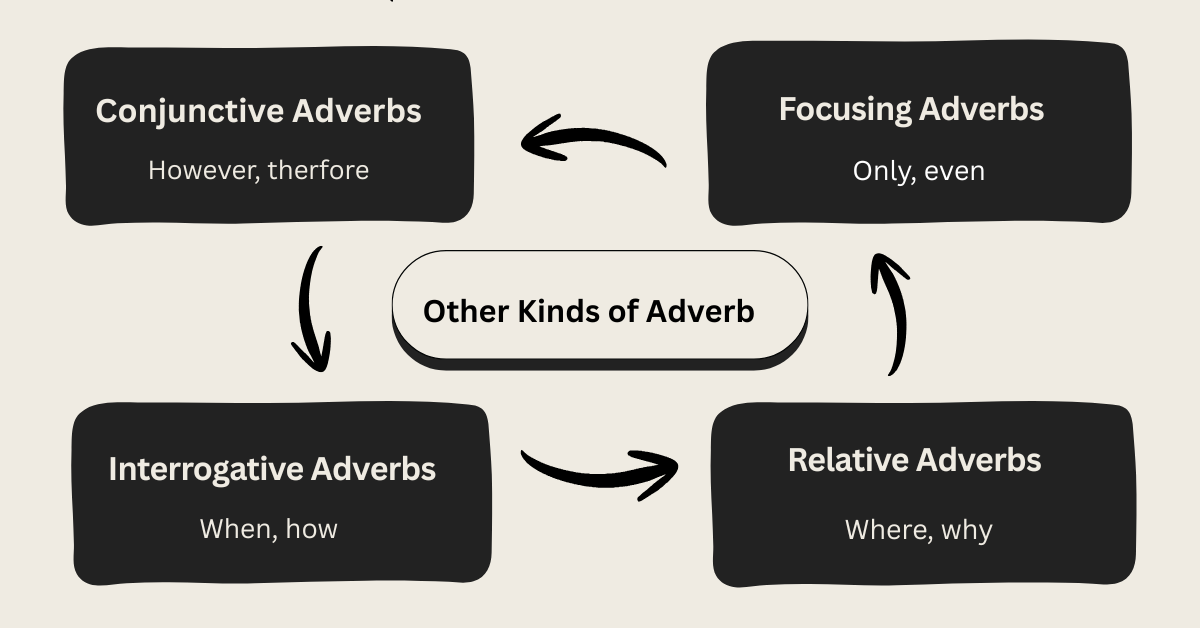
Conjunctive adverbs, Focusing adverbs, Interrogative adverbs, and Relative adverbs are some other kinds of adverbs. Here is a simple breakdown of each:
Conjunctive Adverbs
Conjunctive adverbs are words that connect two independent ideas or sentences. They show relationships like contrast, cause, result, sequence, or emphasis. These adverbs act like bridges between thoughts. They include: however, therefore, moreover, consequently, meanwhile, otherwise
- She studied hard; however, she didn’t pass the test. (contrast)
- It was raining; therefore, we stayed home. (result)
Conjunctive adverbs are usually followed by a comma and are often used after a semicolon.
Focusing Adverbs
Focusing adverbs highlight or limit a specific part of a sentence. They tell us exactly, only, or especially what the speaker wants to emphasize. They include: only, just, even, mainly, especially, etc.
- She only eats vegetables. (nothing else)
- He even apologized. (unexpected action)
Interrogative Adverbs
Interrogative adverbs are used to ask questions. They help us ask about time, place, reason, or manner. They include: when, where, why, and how
- When are you leaving? (time)
- Why are you upset? (reason)
- How did you solve the problem? (manner)
Relative Adverbs
Relative adverbs introduce relative clauses. They give more information about time, place, or reason connected to a noun in the sentence. They include: when (time), where (place), why (reason)
- This is the day when we first met.
- That’s the place where I grew up.
- I know the reason why she left.
Adverb vs Adjective: Simple Difference
Adverbs and adjectives are related but different:
- Adjectives modify nouns. (A happy child.)
- Adverbs modify verbs, adjectives, or other adverbs. (She runs very fast.)
Final Thoughts:
Learning adverbs in simple words helps you add clarity and detail to your sentences. Once you understand their types and usage, English becomes easier, more natural, and more confident.
Leave a Reply