
Adjectives are one of the eight main parts of speech in English. We use them when we describe people, objects, places, and even feelings. If you’ve ever asked, What is an adjective in English grammar, the answer is simple: Adjectives are descriptive words in English that give more information about nouns.
Without adjectives, language feels incomplete. Saying “I bought a phone” sounds plain. Saying “I bought a new smartphone” instantly adds meaning. That is why adjectives matter so much.
What Is an Adjective?
An adjective is a descriptive word that describes nouns or modifies a noun. It can tell us:
- What kind (a blue sky)
- How many (three books)
- Which one (that chair)
In simple words, adjectives act as noun modifiers. They clarify and refine ideas. How do adjectives describe nouns? They share details on size, color, or emotion.
Forms of Adjectives
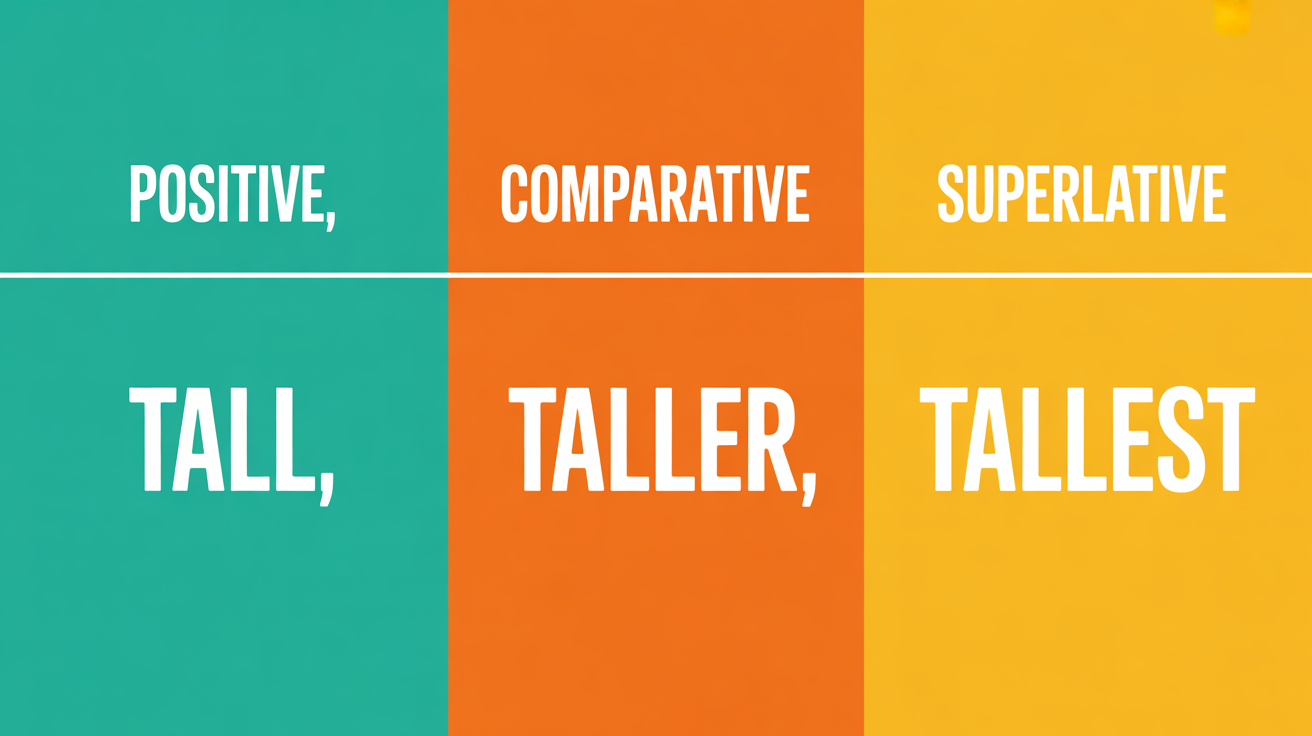
Adjectives have three main forms that show different degrees of comparison: positive, comparative, and superlative.
| Form of Adjectives | Use | Example |
|---|---|---|
| Positive | Basic description | tall |
| Comparative | Compare two things | taller |
| Superlative | Compare three or more | tallest |
1 – Positive Adjectives
Positive adjectives describe a noun without making any comparison. Example: This room is large.
2 – Comparative Adjectives
Comparative adjectives are used when comparing two nouns. Example: This room is larger than the other one.
3 – Superlative adjectives
Superlative adjectives are used when comparing more than two nouns.
Example: This is the largest room in the house.
Types of Adjectives Defined Simply
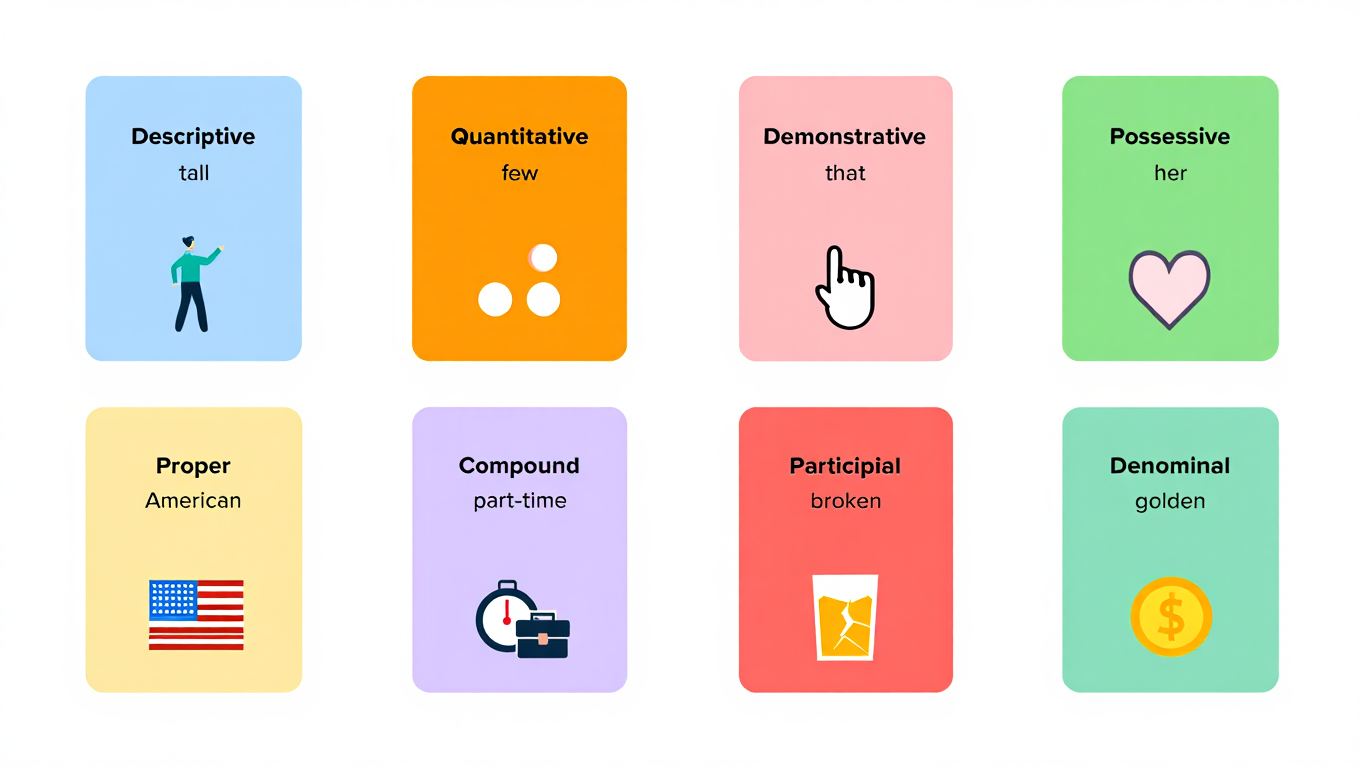
There are many types of adjectives, but the most commonly used ones are easy to understand.
Descriptive Adjectives
Descriptive adjectives describe the quality, size, color, shape, condition, or appearance of a noun. They answer questions like What kind? Or how does it look or feel?
She bought a big red ball for her child.
The old house needs repair.
Quantitative Adjectives
Quantitative adjectives show how much or how many of something there is. They give numerical or general quantity information. Common words: some, many, few, several, all, much
She drank some water after the walk.
He has little patience today.
Demonstrative Adjectives
Demonstrative adjectives point to specific nouns and show distance and number. The four demonstratives are: this, that, these, those
This book is handy.
Those shoes are too expensive.
Possessive Adjectives
Possessive adjectives show ownership or relationship. They always come before a noun. Common possessive adjectives: my, your, his, her, its, our, their
This is my notebook.
They sold their car last year.
Proper Adjectives
Proper adjectives are formed from proper nouns (names of people, places, or cultures). We capitalize proper adjectives always.
She enjoys Italian food.
They watched a Shakespearean play.
Appositive Adjectives
An appositive adjective is an adjective that renames or gives additional information about a noun, often set off by commas or dashes. It works like an appositive noun/ phrase but uses an adjective.
The cake, delicious, was eaten quickly.
His dog, friendly and beautiful, played with the children.
Note: It often appears after the noun and adds descriptive detail.
Compound Adjectives
Compound adjectives are made by combining two or more words to describe a noun. They are often hyphenated.
He is a well-known author.
He works a full-time job.
Comparative Adjectives
Comparative adjectives are used to compare two nouns. They usually end in -er or use more.
Max is taller than Musa.
This lesson is more interesting than the last one.
Superlative Adjectives
Superlative adjectives are used to compare three or more nouns. They usually end in -est or use most.
This is the largest room in the house.
That was the most exciting day of my life.
Nominal Adjectives
Nominal adjectives function like nouns or are derived from nouns to describe other nouns. They often indicate nationality, material, or category. They usually follow the definite article _the.
Wooden tables are expensive. (Derived from the noun wood)
She loves Italian cuisine. (Derived from the proper noun Italy)
Denominal Adjectives
Denominal adjectives are directly formed from nouns. They describe a noun by showing relationship, origin, or possession. They are very common in English.
Childish behavior annoys adults. (from noun child)
Governmental policies affect everyone. (from noun government)
Note: Denominal adjectives often end in suffixes like -al, -ic, -y, -ish, -ful, and describe characteristics or qualities of the original noun.
Participial Adjectives
Participial adjectives come from verbs and usually end in -ing or -ed. People often confuse them, so understanding their meaning is important.
- -ing adjectives describe the cause of a feeling
- -ed adjectives describe how someone feels
The movie was boring, so we left early.
The children felt excited before the trip.
How to Use Adjectives in Sentences
Most adjectives come before nouns, but some appear after linking verbs.
- Before noun: a cold night
- After verb: The night feels cold.
Avoid using too many adjectives together. Clear and simple sentences always sound better.
Adjectives play a key role in making English expressive and precise. By understanding adjectives, their forms, and types, you can describe ideas more clearly and confidently.
This guide gives you a strong foundation. Practice using adjectives in everyday sentences, and over time, your English will sound more natural and fluent.
Leave a Reply