
Struggling with pronouns in English Grammar? Many ask, “What is a pronoun and how is it used? Pronouns Replace Nouns but Shift Forms in Tricky Ways depending on their role in a sentence.
In this post, you’ll learn the definition of pronouns, explore different types of pronouns in English, and see pronoun examples for learners to make each type easy to understand. You’ll master correct pronoun usage fast.
What are Pronouns: Simple Definition
Pronouns are a small but powerful part of speech in the English language. A pronoun is a word we use instead of a noun (names or objects), so we don’t keep repeating the same name or thing again and again. They refer to people, things, or ideas that have already been mentioned or understood from context. For example: “Blackie is my dog. He is beautiful and sharp.”
Some common pronouns include: I, me, he, she, it, they, them, this, that, who
All Types of Pronouns You Need to Know
Types of pronouns spark life into your sentences—think of them as grammar superheroes swapping in for nouns! Once you know the categories, it’s easier to spot mistakes and use them correctly.
Pronoun types explained with examples help learners understand how each pronoun works in real sentences. Ready to level up?
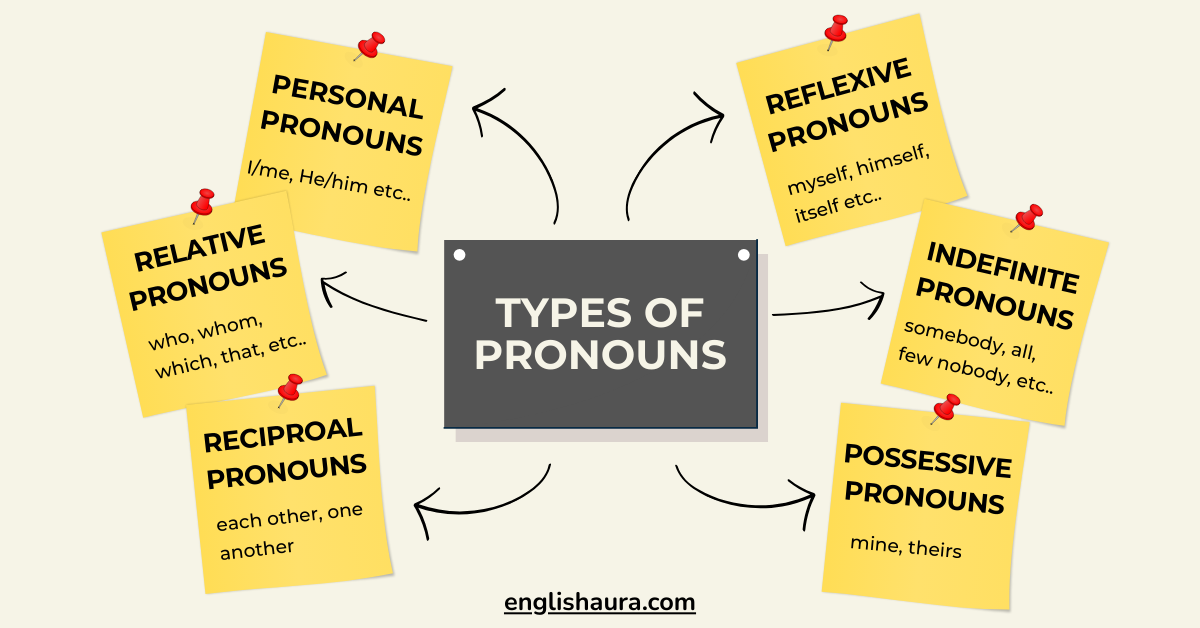
1 – Personal Pronouns
Personal pronouns are one of the most common pronoun types in English grammar. These are the words we use to replace a person’s name. Examples: I, me, he, him, she, her, we, us, they, them.
These pronouns are used according to their grammatical persons. Personal pronouns can be subject pronouns or object pronouns:
- Subject Pronouns do the action in a sentence. Put them first.
- I run fast. (I do the running.)
- She reads books.
- It shines bright.
- We play cricket.
- They eat rice.
- Object pronouns receive the action. Put them after verbs or prepositions.
- She sees me. (Me gets seen.)
- Help her now.
- Kick it away.
- Call us soon.
- Tell them the truth.
Tips to avoid mistakes:
- Use I, he, she, we, they when the pronoun does the action.
- Use me, him, her, us, them when the pronoun gets the action.
- Read the sentence aloud. Ask: Who is doing the action? Who is getting it?
Using personal pronouns correctly helps avoid subject vs object pronoun confusion.
2 – Reflexive vs Intensive Pronouns
Reflexive pronouns, such as myself, himself, and herself, indicate that the action goes back to the subject. They are the forms of personal pronouns and often end on _self or _selves. Therefore, these pronouns help clarify meaning in English sentences.
| Reflexive Pronoun | Example Sentence |
|---|---|
| myself | I taught myself to play guitar. |
| yourself | You should take care of yourself. |
| himself | He prepared himself for the exam. |
| herself | She introduced herself to the class. |
| itself | The cat cleaned itself. |
| ourselves | We organized ourselves for the trip. |
| yourselves | You all need to help yourselves. |
| themselves | They blamed themselves for the mistake. |
On the other hand, Intensive pronouns are used to emphasize or highlight the subject. They do not show action, back to the subject. They highlight who does the action.
- I did it myself. (Stresses “I alone.”)
- She herself fixed the error. (Emphasizes “she.”)
3 – Relative Pronouns
As the very name shows, these pronouns relate/ connect two parts of a sentence. They often link a main idea to extra information about a person, place, thing, or idea. Key Relative Pronouns are: who, whom, which, whose, that.
- Who → refers to people (subject of the clause)
- The girl who sings is talented.
- Whom → refers to people (object of the clause)
- The teacher whom you met is kind.
- Which → refers to things or animals
- The book which I read was fun.
- Whose → shows possession/ ownership
- The girl whose bag was lost is crying.
- That → can refer to people or things (used in essential clauses)
- This is the song that I like.
4 – Indefinite Pronouns
Indefinite pronouns are words that talk about people, things, or places without naming them specifically. They include someone, anyone, everyone, no one, nobody, somebody, everybody, all, few, many, something, nothing.
- Everyone forgot his or her pen.
- Somebody is at the door.
- Nothing seems right today.
Usage tips:
- They do not refer to a particular person or thing.
- Often require singular verbs (everyone is, someone has).
- Can cause agreement errors with pronouns (everyone → his/her, not their in formal writing).
5 – Demonstrative Pronouns
These pronouns point to specific things. They show near or far, one or many. The main ones are: this, that, these, those.
- This (near and singular): This is my notebook.
- That (far and singular): That is your pen.
- These (near, many/ plural): These are books.
- Those (far, many/plural): Those are chairs.
6 – Reciprocal Pronouns
Reciprocal pronouns are just two that show mutual action between people or elements. Use “each other” (for two) or “one another” (for more).
- They helped each other with homework.
- The friends hugged one another.
7 – Possessive Pronouns
Possessive pronouns show ownership or possession. They stand alone: mine, yours, his, hers, its, ours, theirs.
- This book is mine.
- The house is theirs.
8 – Interrogative Pronouns
Interrogative pronouns are used to ask questions. They are: who, whom, whose, what, which.
- Who is at the door?
- Which pen is yours?
9 – Distributive Pronouns
Distributive pronouns refer to individuals in a group separately. Main ones: each, either, neither.
- Each student has a notebook.
- Neither of the options is correct.
Pronoun-Antecedent Agreement
Pronoun–antecedent agreement explains how pronouns relate to the nouns they replace.
- Wrong: Everyone lost their book.
- Correct: Everyone lost his or her book.
Leave a Reply