
What is a Noun in Parts of Speech?
A Noun is the name of a person, place, thing, animal, concept, or idea. In simple terms, every object that has a name is a noun. Master nouns first to conquer parts of speech.
For example, Sara (person), London (place), book (thing), and happiness (idea) are all nouns. Knowing what a noun is in English grammar is essential because nouns form the foundation of sentences.
Nouns can act as subject and object nouns. This means a noun can be the “doer” of an action or the “receiver” of an action. For example, in “The dog chased the ball,” the dog is the subject noun, and the ball is the object noun. Learning to identify nouns in a sentence is easier when you look for naming words or use clues like articles (a, an, the) and common noun endings (-tion, -ness, -ment, -ity).
Examples:
- Person: teacher, Ahmed, girl, doctor, mother, friend
- Place: school, park, city, home, shop, bank
- Thing: book, chair, pen, phone, bag
- Animal: dog, lion, bird, fish, horse
- Concept/idea: love, happiness, honesty, time
Nouns in Sentences:
- The teacher is in the classroom.
- The dog plays with the ball.
- I read a book in the park.
- Honesty is the best policy.
- The cat sleeps on the chair.
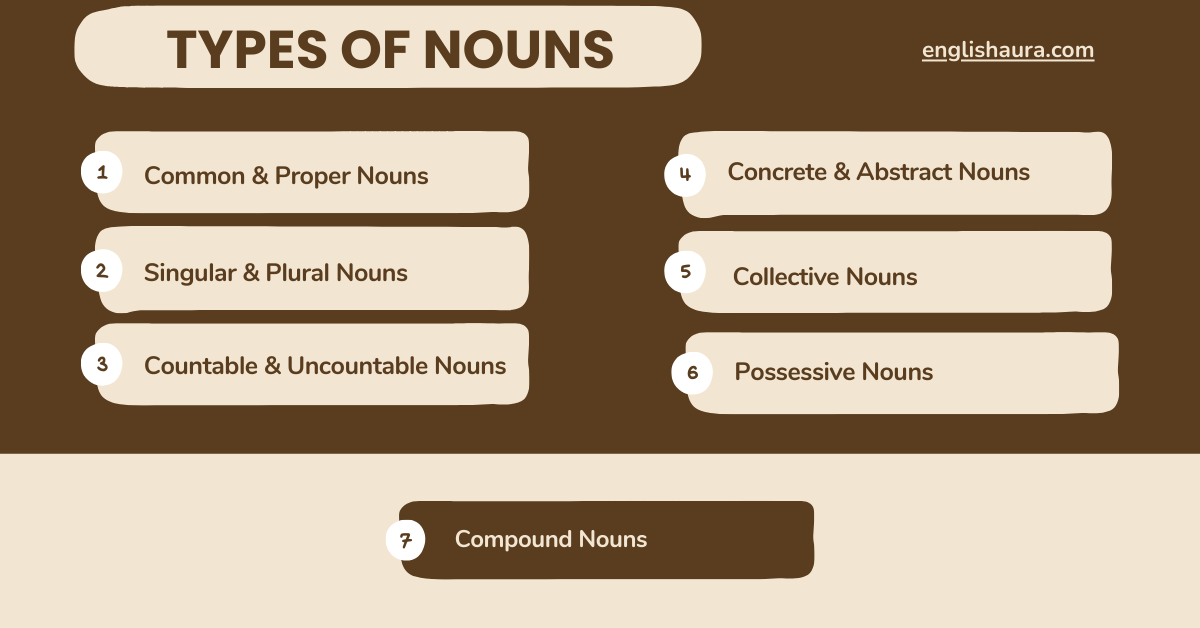
Types of Nouns
Beginners often ask, “What are the types of nouns?” Let’s break them down in the simplest way.
1. Common & Proper Nouns
Common nouns are the names of common/ general people, places, things, animals, or ideas, like (girl, city, dog, car).
- I have a dog.
- The book is on the table.
- She bought a new phone.
While proper nouns name specific or special people, places, or brands (like Sara, London, or Coca-Cola). Proper nouns always start with a capital letter.
- Ali is my best friend.
- We live in Lahore.
- I like Coca-Cola.
2. Singular & Plural Nouns
Singular nouns name just one item or person, like a child, a dog, or a book. They stand alone for single things.
- The cat sleeps quietly on the soft.
- A boy runs fast across the green park after school.
- One dog barks.
Plural nouns, on the other hand, refer to more than one, such as children, dogs, or books. Most follow simple singular vs plural form rules:
- Dogs chase the ball.
- I see books in a bookshop.
- Cats play outside.
Regular nouns: Add -s (cat → cats) or -es for words ending in -s, -sh, -ch, -x, or -z (bus → buses, church → churches).
Irregular nouns: Change completely, like mouse → mice, man → men, foot → feet, or child → children. These don’t follow standard rules—memorize them!
Quick tip: Always match nouns with verbs (singular: The child plays; plural: The children play). Practice spotting them to boost your grammar skills.
3. Countable & Uncountable Nouns
Countable nouns refer to items you can count individually, like an apple or a book. They have singular and plural forms (e.g., one apple, two apples). Use these with numbers or quantifiers:
- She has two pencils.
- I ate an apple.
- We bought three bags.
Uncountable nouns or mass nouns represent things you can’t count separately, like water, advice, or music. They usually stay singular and don’t take “a/an.” Use quantifiers like much, little, some, or a lot of:
- Adam drank some water.
- We enjoyed the music.
- She needs more sugar.
4. Concrete & Abstract Nouns
Things you can touch, see, hear, smell, or taste, like a table, water, or music, are Concrete Nouns.
- He kicks a ball.
- We touch the door.
- Sadaf eats an apple.
Abstract nouns represent ideas or emotions that cannot be touched by our senses or do not have physical existence, like love, freedom, or courage.
- I feel great joy today.
- She shows love.
- He finds peace in nature.
5. Collective Nouns
Collective nouns name groups of people, animals, things, or ideas treated as a single unit, like “team” or “herd.” They differ from plural nouns by referring to the group as one entity, though members can act individually.
- The family eats dinner.
- An audience cheers loudly.
- The team plays well.
6. Possessive Nouns
Possessive nouns show ownership or belonging by adding an apostrophe and sometimes by adding the letter “s.” They turn regular nouns into ones that indicate “who owns what,” making sentences clearer and more precise.
Key Rules
- Singular nouns: Add ‘s (apostrophe + s).
Example: The dog’s bone is buried. (One dog owns one bone.) - Plural nouns ending in s: Add just ‘ (apostrophe after the s).
Example: The dogs’ bones are buried. (Multiple dogs own multiple bones.) - Plural nouns not ending in s: Add ‘s.
Example: The children’s toys are scattered. (Multiple children own toys.) - Singular nouns ending in s: Still add ‘s (e.g., James’s car), though some styles use just ‘ for names like Jesus’ teachings.
Common Pitfalls
- Don’t confuse with plurals: “dogs” (more than one dog) vs. “dogs’ bones” (bones belonging to dogs).
- For joint ownership, use ‘s on the last noun: “Mom and Dad’s house.”
- Its vs. it’s: “Its bone” (the dog’s bone) vs. “it’s (it is) chewing.
Practice tip: Rewrite “the book of the teacher” as “teacher’s book.”
7. Compound Nouns
Compound nouns combine two or more words to create a single noun with a new meaning. They often function as one unit in a sentence, like “toothbrush” instead of separate “tooth” and “brush.” Recognizing them boosts your grammar skills by clarifying how words team up.
Three Main Forms
- Closed: Words smashed together without spaces.
Examples: notebook, toothbrush, sunlight. - Hyphenated: Words linked by a hyphen for clarity.
Examples: mother-in-law, check-in, runner-up. - Open: Separate words acting as one noun.
Examples: ice cream, post office, full moon.
Noun: More Jobs and Functions
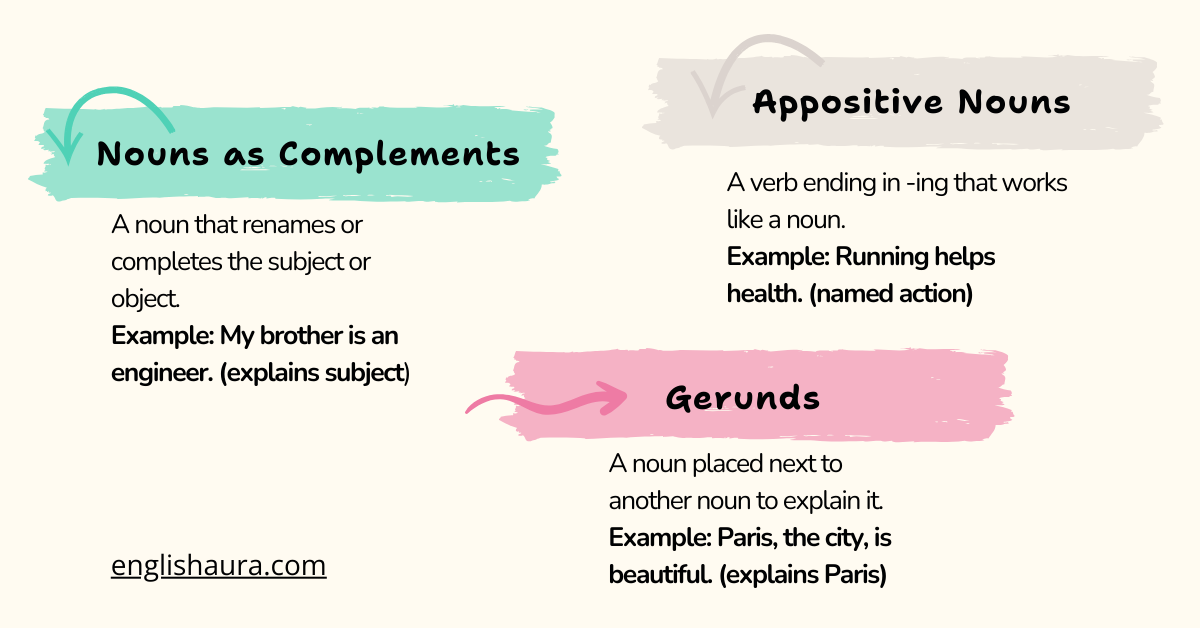
Nouns as Complements
Noun complements rename or describe the subject or object. They complete the meaning after a linking verb like “is” or “seems.”, e.g., She is a teacher. (Teacher renames “she.”)
Gerunds
Gerunds are verbs ending in -ing that act like nouns. They name activities and can be subjects, objects, and more, e.g., Swimming is fun. (Swimming is the subject, like a noun.)
Appositive Nouns
Appositive nouns rename or explain another noun right next to it, often set off by commas, e.g., My friend, a chef, cooks well. (Chef renames “my friend.”)
Advanced Tip: Generic Nouns
Generic nouns refer to a whole group or class, not specific ones. They represent “all” or “any” of something, e.g., The lion is brave. (Means lions in general, not one lion.)
If you want to continue learning step-by-step, explore these useful guides:
- Parts of Speech (Beginner Guide)
- Basic English Tenses with Examples
- Simple Punctuation Rules for Beginners
FAQs About Noun
To identify nouns in a sentence, look for naming words and words that come after articles (a, an, the). You can also check if the word works as a subject or object noun. A simple test is asking: Is it a person, place, thing, or idea? If yes, it is likely a noun.
Gerunds are verbs ending in -ing that function as nouns, like “Swimming is fun.” Regular nouns name people, places, or things directly, but gerunds name actions, e.g., “I enjoy reading.”
Generic nouns refer to a whole class, not specifics: “The lion is brave” (lions generally) or “Cats hate water” (cats as a group). No “the” for one particular lion or cat.


Leave a Reply