
Learning the parts of speech for beginners is key to mastering English grammar. Every word has a role we must know. In this straightforward guide, you will learn about parts of speech in simple terms, along with easy examples to clarify each type.
What Are Parts of Speech?
Parts of speech in simple words are like family groups for words—they tell us each word’s job in a sentence. They help us understand whether a word names something, shows action, describes, or connects ideas.
Traditionally, English has 8 parts of speech: nouns, pronouns, verbs, adjectives, adverbs, prepositions, conjunctions, and interjections—though modern grammar adds extra groups like determiners and articles for clearer explanation. For beginners, learning the main 8 types is the easiest way to understand the basic parts of speech.
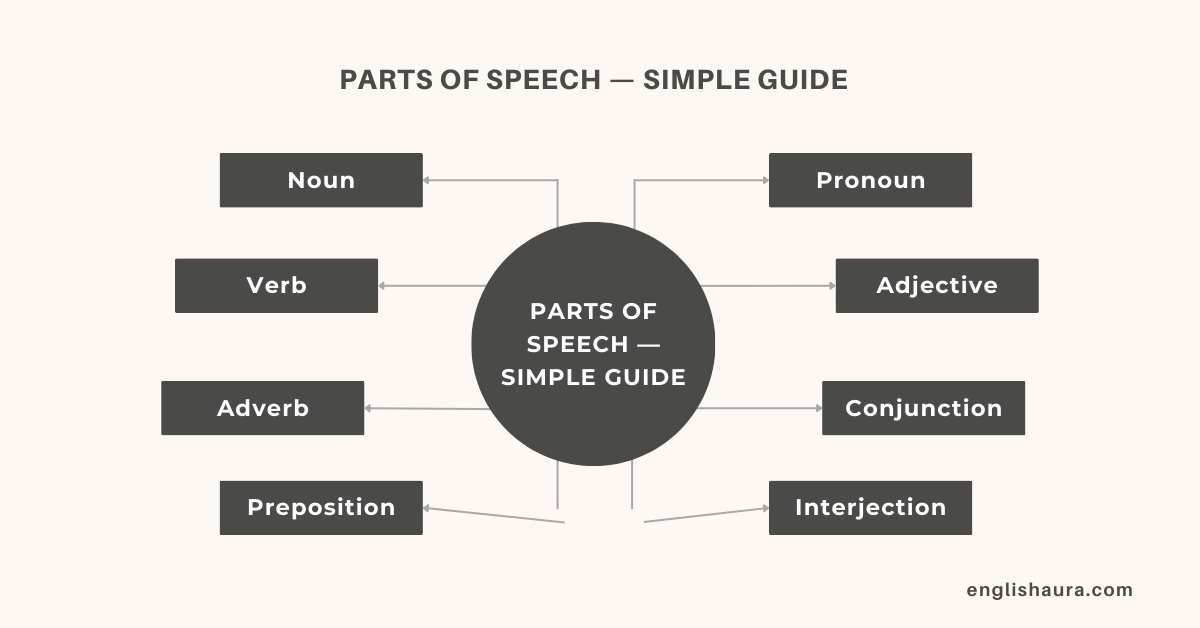
Parts of Speech Made Easy: Learn All 8 Types
Noun
A Noun is the name of a person, place, thing, concept/ idea. Nouns belong to the word class that shows “who” or “what” a sentence talks about. Nouns can be common (general names like dog, city, book) or proper (specific names like Sara, London, Amazon). They can also represent abstract ideas such as happiness, love, or freedom.
Examples:
- Person: Sara, teacher, doctor
- Place: school, park, Paris
- Thing: dog, book, chair
- Idea: happiness, courage, freedom
Sentences:
- The dog played in the park.
- Sara loves reading books every evening.
- Happiness is the key to a peaceful life.
Pronoun
A pronoun replaces a noun to avoid repetition. It stands for a noun already mentioned or easily understood in the context. Common pronouns: He, she, it, they, and you.
Example Sentences:
- Sara is kind, and she helps everyone.
- They play soccer every weekend.
- It is a bright sunny day.
Verb
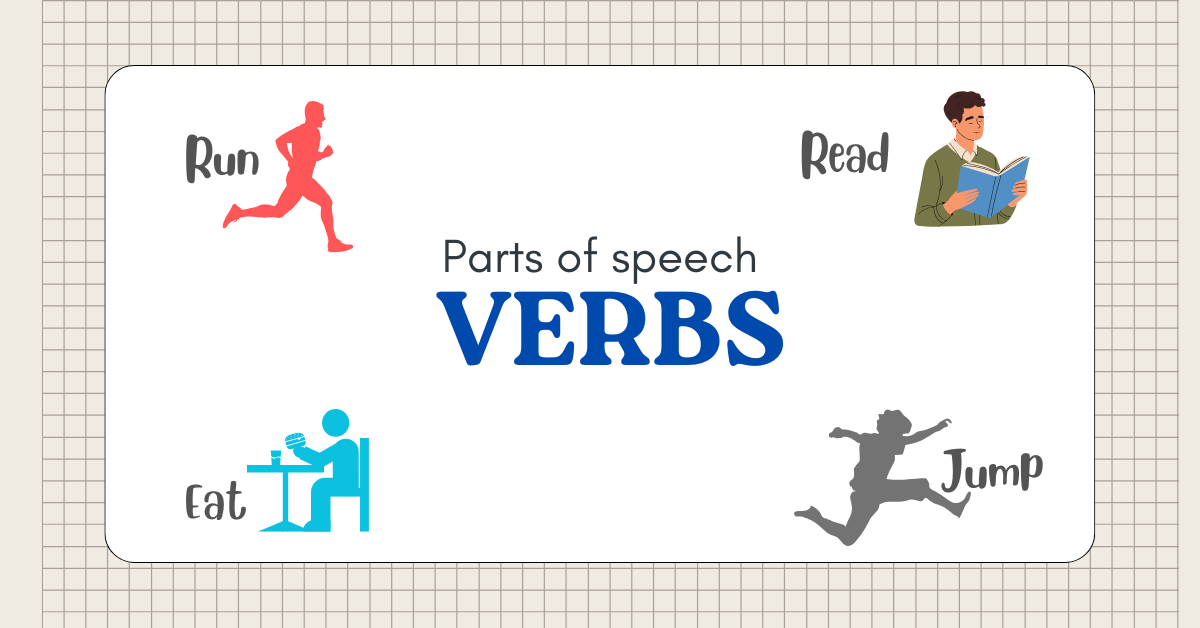
Verbs show action or a state of being. Action verbs describe what someone does, while state verbs describe a condition, feeling, or existence. Common Verbs: run, jump, read, is, am, feel, think
Example Sentences:
- Birds fly high in the sky.
- She eats an apple daily.
- He thinks about his future.
Adjective
Adjectives describe a noun or pronoun, giving more information about its size, color, shape, or quality. Common Adjectives: big, blue, round, kind
Example Sentences:
- The blue sky shines bright.
- She has a big red balloon.
- The happy child laughs loudly.
Adverb
An adverb modifies (gives more information about) a verb, an adjective, or another adverb, often ending in -ly for the adjectives (e.g., “fast” becomes “fastly”). However, not all adverbs end with -ly. It usually tells how, when, where, or to what degree an action happens. Adverbs add detail and clarity to a sentence. Common Adverbs: quickly, today, outside, very, now
Example Sentences:
- She sings beautifully on stage.
- He runs quickly to school.
- Come here right now.
Preposition
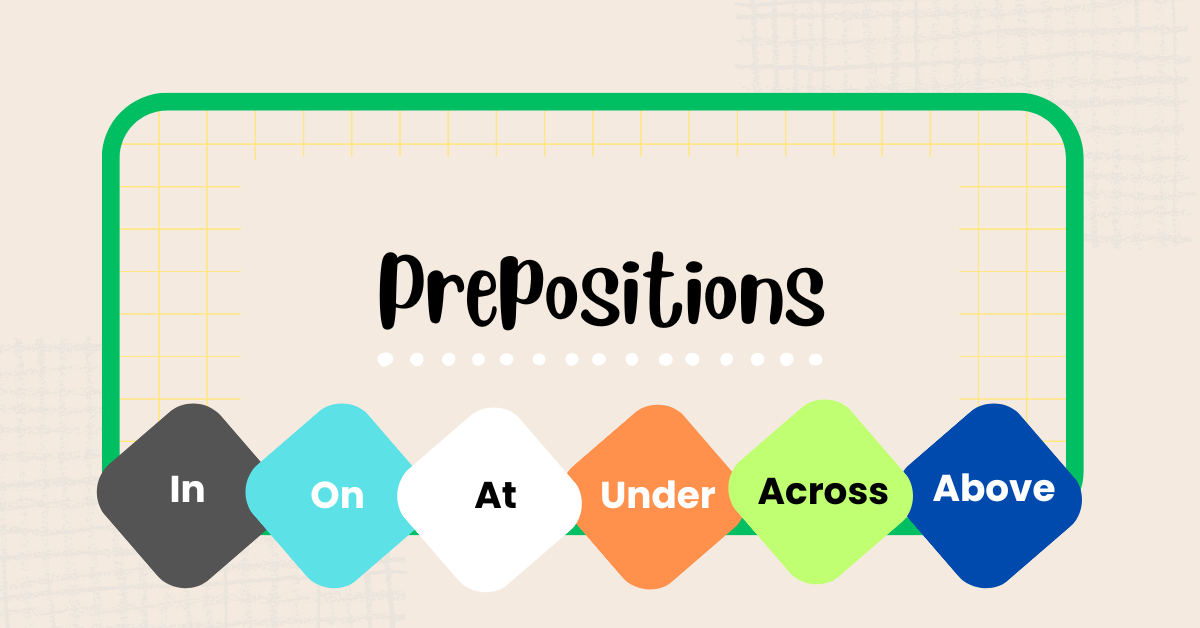
A preposition is a word (e.g., “on“) or a phrase (e.g., “in front of“) that shows the relationship between a noun or pronoun and another word in a sentence. It often indicates time, place, or direction. Common Prepositions: in, on, under, before, near, between
Example Sentences:
- The book is on the table.
- The keys are under the mat.
- She walked in front of the class.
Conjunction
Conjunctions connect words, phrases, or clauses. They help sentences flow and show the relationship between ideas. Common types are coordinating conjunctions (and, but, or) and subordinating conjunctions (because, although). Common Conjunctions: and, but, or, because, although
Example Sentences:
- I like tea and coffee.
- She is small, but very strong.
- Stay home because you are sick.
Interjection
An interjection expresses a sudden feeling or emotion. Interjections are usually short and often followed by an exclamation mark. They show surprise, joy, pain, or other emotions. Common Interjections: Wow!, Hey!, Oops!, Oh!
- Wow! What a beautiful view.
- Oh! I forgot my keys.
- Oops! I dropped it.
This beginner’s guide makes parts of speech made easy with parts of speech with easy examples. Practice these basic grammar parts of speech daily to improve writing and speaking. Start today for better English!
FAQs About Parts Of Speech
Nouns, pronouns, verbs, adjectives, adverbs, prepositions, conjunctions, and interjections are 8 Parts of Speech in English Grammar.
Articles and determiners are also considered in Parts of Speech in Modern Grammar.
They help you understand how sentences are built and make writing clearer.
Practice daily, read simple sentences, and identify each word’s role.
Leave a Reply