
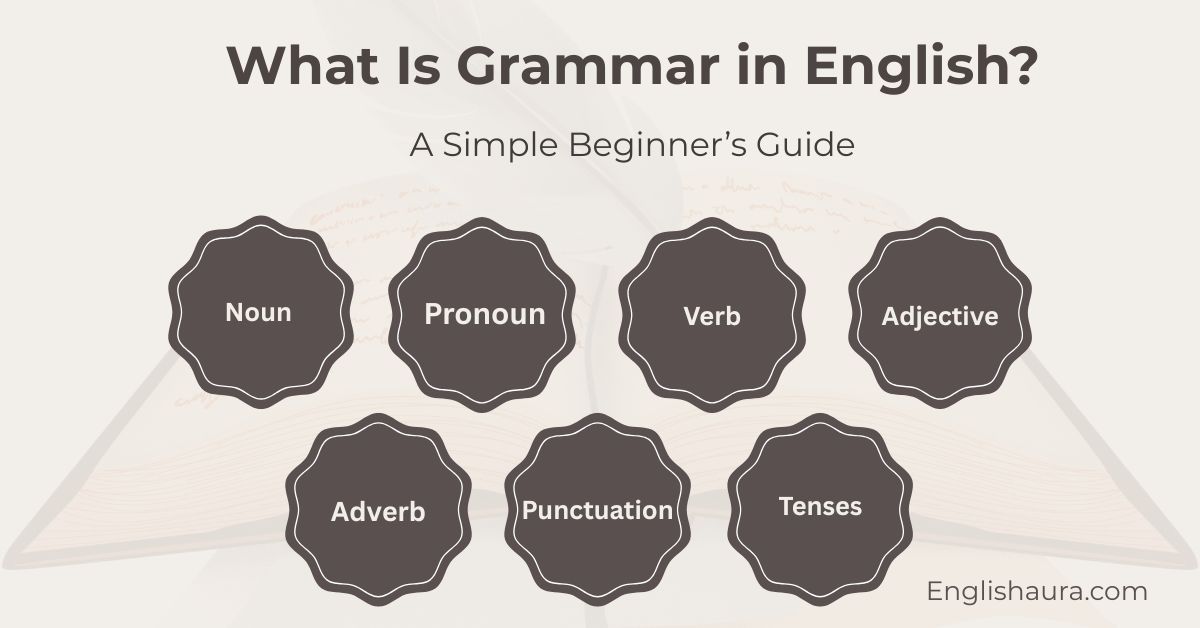
Grammar is simply the set of rules that helps us arrange words to create clear, meaningful sentences.
In other words, it gives structure to sentences so your ideas make sense. For beginners, grammar may seem hard at first; however, clear examples and small steps make learning easier. In this guide, you will learn what grammar is in English, why it matters, the main parts to focus on, and simple examples to practice.
Why Grammar Matters for Beginners
For beginners, grammar is important because it makes communication clearer and more confident—whether you’re speaking, writing emails, or posting online. When you understand basic grammar, you can form correct sentences, avoid common mistakes, and express your thoughts more accurately.
Key Components of English Grammar
To learn English grammar and feel confident with the basics, focus on a few main areas. First, study the parts of speech. Next, practice sentence structure and syntax. Also, learn common tenses and basic punctuation. Finally, pay attention to agreement and word order so your sentences sound natural.
1. Parts of Speech:

Every word in English fits into eight categories:
- Nouns (person, place, thing, e.g., dog)
- Pronouns (he, she, it)
- Verbs (actions or states, e.g., run)
- Adjectives (descriptive words, e.g., happy)
- Adverbs (modify verbs, e.g., quickly)
- Prepositions (location/time words, e.g., in)
- Conjunctions (connecting words, e.g., and)
- Interjections (emotional expressions, e.g., Wow!)
This helps you understand parts of speech in English and their usage.
2. Sentence Structure & Syntax:
Most English grammar lessons follow the Subject–Verb–Object (S-V-O) structure. Example: “The cat (S) chased (V) the mouse (O).”
As a result, Sentences can be simple, like the one above, or compound (two simple sentences joined), or complex (one sentence depending on another). Therefore, understanding English sentence structure for beginners helps them express ideas with variety and clarity.
3. Tenses & Verb Forms:
They tell us when something happens—past, present, or future. Correct tenses ensure clarity. Simple sentences:
- “I eat” (present)
- “He ate” (past)
- “They will eat” (future)
Tense consistency is a fundamental concept in English grammar basics.
4. Punctuation & Mechanics:
English punctuation marks, such as commas, periods, and apostrophes, are the traffic signals of writing. Hence, they instruct your reader when to pause, stop, or focus on a specific detail. Example:
“Let’s eat, Grandma!” vs. “Let’s eat Grandma!”
5. Agreement and Word Order Rules:
This principle ensures that different parts of your sentence work together harmoniously. For example:
- A singular subject needs a singular verb (“The dog barks”)
- A plural subject needs a plural verb (“The dogs bark”).
Types of Grammar
Grammar isn’t one-size-fits-all. Different approaches serve different purposes:
- Prescriptive Grammar: Explains how language should be used.
- Descriptive Grammar: How people actually speak and write.
- Traditional Grammar: Focuses on parts of speech and rule memorization.
- Modern/Functional Grammar: Looks at patterns, meaning, and real-life communication. It’s more practical and flexible for today’s learners.
Essential Grammar Patterns for Beginners
- Articles & Determiners: a, an, the (I saw a cat / the cat).
- Prepositions: in, on, at (I’m at school, on Monday, in the morning).
- Modal Verbs: can, should, must (She can swim. You must try).
- Conditionals: If it rains, we’ll stay home.
Common Grammar Mistakes Beginners Make
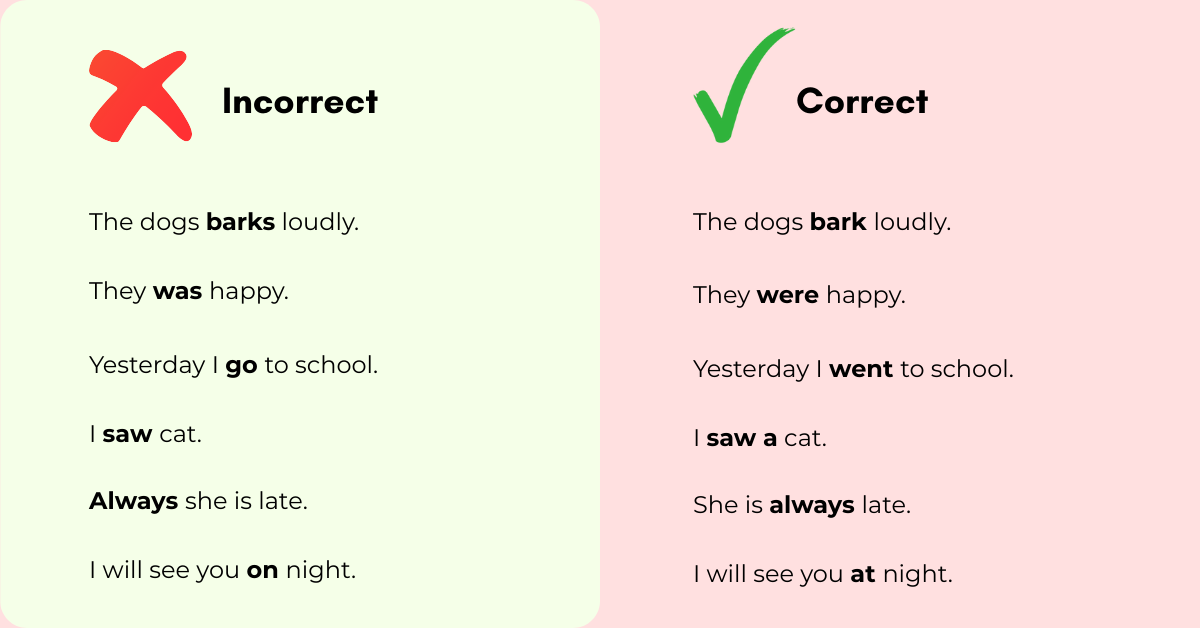
1 – Subject–Verb Disagreement
- Wrong: They was happy.
- Correct: They were happy.
- Explanation: Plural subject → plural verb.
2 – Incorrect Tense
- Wrong: Yesterday I go to school.
- Correct: Yesterday I went to school.
- Explanation: Past events need the past tense.
3 – Missing Articles
- Wrong: I saw cat.
- Correct: I saw a cat.
- Explanation: Singular countable nouns need a/an/the.
4 – Wrong Word Order
- Wrong: Always she is late.
- Correct: She is always late.
- Explanation: Adverbs usually go after the verb “be”.
Grammar is your helper — it makes speaking and writing clearer and boosts your confidence. Start small and practice a little every day; over time, your grammar will improve. If you want more help, check the linked beginner guides below and try the short exercises.
If you want to continue learning step-by-step, explore these useful guides:
- Parts of Speech (Beginner Guide)
- Basic English Tenses with Examples
- Simple Punctuation Rules for Beginners
Finally! More short and beginner-friendly lessons are coming soon!
Leave a Reply