
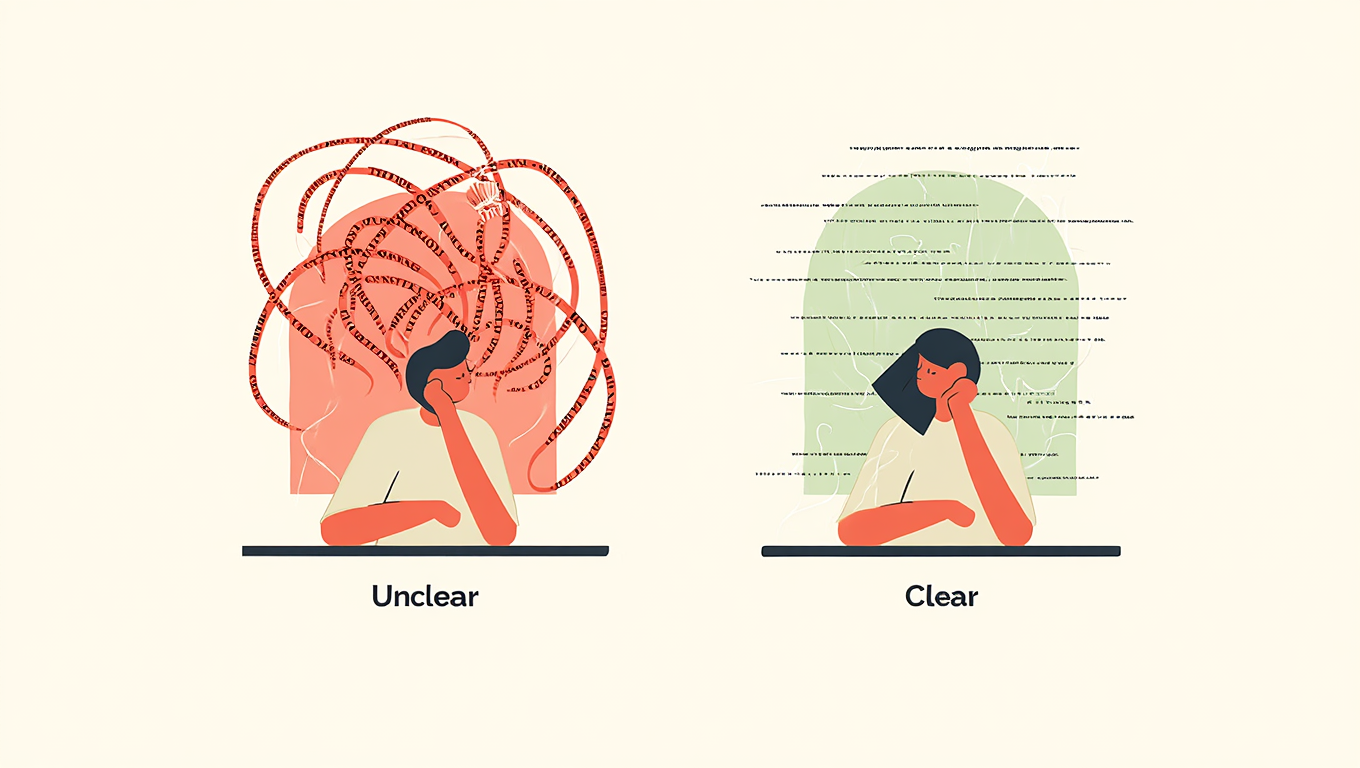
Most people don’t realize their sentences are unclear—until someone asks, “What do you mean?”
That moment? That’s exactly what unclear writing does.
😵 “Readers told writers they were confusing.” Wait — who’s confusing whom? The writers? The readers? If you had to re-read that, you’ve felt the frustration this post fixes.
Unclear sentences trip up everyone: ESL learners translating word-for-word from their native language, students stacking clauses to impress, or anyone rushing without a quick check. They make your ideas hard to grasp, leaving readers frustrated and your message lost.
What is an unclear sentence?
An unclear sentence confuses the reader due to vague words, poor structure, or misplaced phrases. It forces the reader to stop, re-read, and guess the meaning.
What is the fix? Clear writing significantly improves understanding and reduces re-reading. Sentence clarity fixes take seconds once you know the patterns.
You’ll get 10 real unclear sentence examples with simple fixes, grouped into ambiguity, misplaced modifiers, and wordy traps. Each has a table showing the issue, rewrite, and impact on your reader to improve writing clarity instantly. Let’s make your words crystal clear.
Types of Unclear Sentences
Unclear sentence examples fall into three common traps you can fix in seconds:
- Ambiguous sentences: Words or pronouns with double meanings—who or what is it about?
- Misplaced modifiers: Descriptions attaching to the wrong word, creating funny or confusing mix-ups.
- Wordy/passive constructions: Filler words or flipped structure hiding your main idea.
How to Fix Unclear Sentences (Quick Answer)
- Use specific nouns instead of pronouns
- Keep modifiers close to the word they describe
- Remove unnecessary words
- Use active voice
- Keep one idea per sentence
The Most Common Mistake Even Good Writers Make
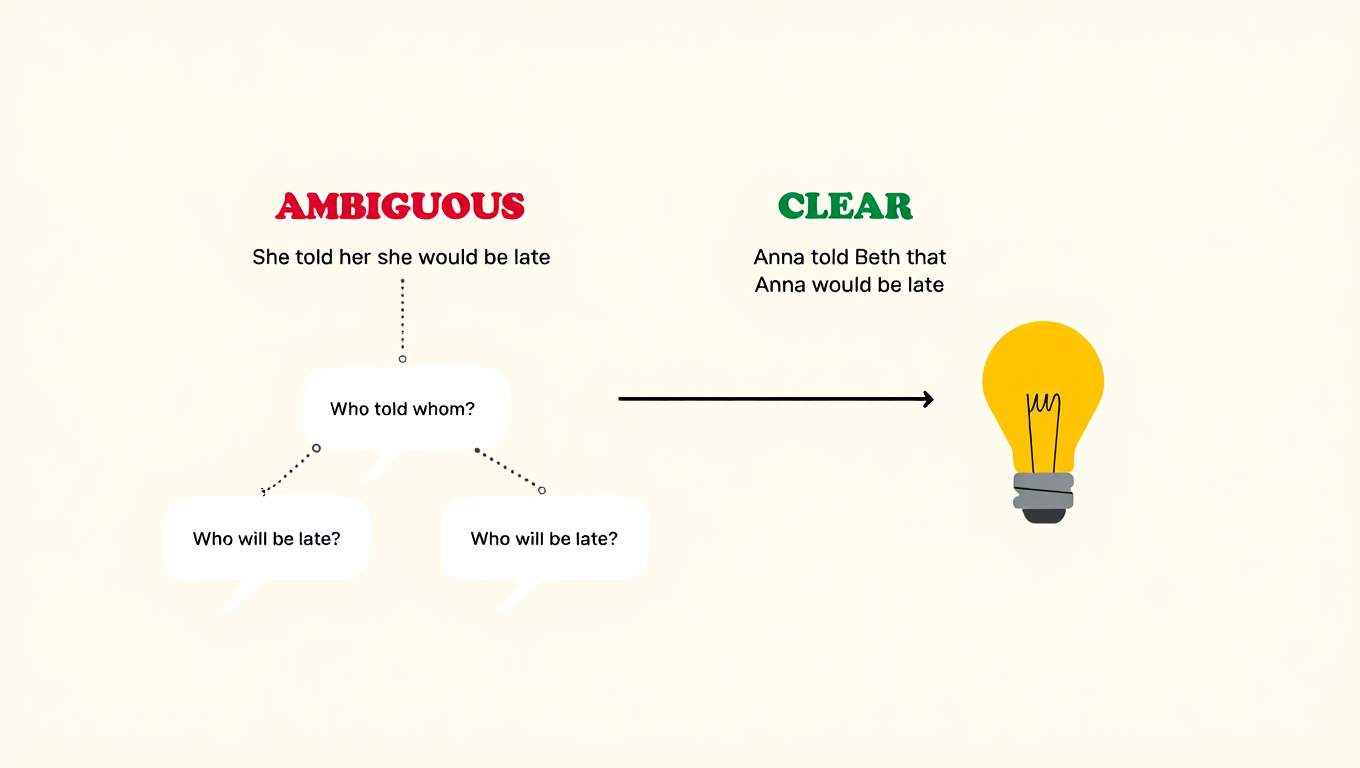
Even experienced writers make unclear sentences—not because they don’t know grammar, but because they rely too much on their own understanding.
Words like “this,” “it,” and “they” feel clear in your mind. But your reader doesn’t share that context.
For example:
“This improves writing.”
You know what “this” means. Your reader doesn’t.
That gap between what you mean and what the reader understands is where unclear writing happens.
👉 The fix is simple: write for the reader, not your own understanding.
Ambiguous Sentences
Ambiguous sentences leave readers guessing pronouns or meanings. Here’s how to fix three classics.
| Unclear Sentence | Problem | Clear Sentence | Why It’s Better |
|---|---|---|---|
| Example: 1 Readers told writers they were confusing. | “They” is unclear | Readers told writers the posts were confusing. | Removes confusion about who “they” refers to. |
| Example: 2 Sarah told Maria she failed. | Unclear subject (who failed?) | Sarah told Maria that Maria failed. | Clearly shows who failed. |
| Example: 3 I saw a blogger with a laptop. | Meaning is ambiguous | I saw a blogger using a laptop. | Makes the meaning precise. |
Pro Tip: Read aloud—if you pause to think “who?”, rewrite.
Misplaced Modifiers
Modifiers (describing words/phrases) stick to the wrong thing, dangling awkwardly. Fix by placing them next to what they describe.
| Unclear Sentence | Problem | Clear Sentence | Why It’s Better |
|---|---|---|---|
| Example: 4 Running late, the deadline passed me. | Misplaced modifier (deadline can’t run) | Running late, I missed the deadline. | Clearly shows who is running late. |
| Example: 5 Covered in chocolate, we ate strawberries. | Modifier attached to the wrong subject | We ate strawberries covered in chocolate. | Correctly describes the strawberries, not “we.” |
| Example: 6 She almost wrote 50 posts. | Misplaced “almost” changes meaning | She wrote almost 50 posts. | Shows she actually wrote many posts, not none. |
Pro Tip: Ask: “What’s really doing the action?”
4 Wordy/Passive Sentences
Readers lose interest here without realizing why. When they see extra words or passive voice (e.g., “was done by” instead of “did”).
| Unclear Sentence | Problem | Clear Sentence | Why It’s Better |
|---|---|---|---|
| Example: 7 Readers told writers they were confusing. | “They” is unclear | Readers told writers the posts were confusing. | Removes confusion about who “they” refers to. |
| Example: 8 Sarah told Maria she failed. | Unclear subject | Sarah told Maria that Maria failed. | Clearly shows who failed. |
| Example: 9 I saw a blogger with a laptop. | Meaning is ambiguous | I saw a blogger using a laptop. | Makes the meaning precise. |
| Example: 10 This improves writing. | Vague “this.” | Reading aloud improves writing. | Add a noun after vague words. |
Pro Tip: Aim for 15-20 words max per sentence.
Why You Write Unclear Sentences
You might think complex sentences sound smart, but they confuse readers. Common traps:
- Sound-smart myth: Long clauses = unclear (Hemingway wrote short, clear prose).
- Rushed writing: Brain fills gaps while drafting; readers can’t.
- ESL habits: Word-for-word translation from your native language creates odd structures.
- No proofreading: Skipping a read-aloud misses 80% of issues.
Key insight: Simple = smart. Clear writing connects faster—practice beats perfection.
5-Min Clarity Checklist
Run this before finishing any writing. Cuts confusion instantly.
- Read aloud—stumble or re-read? Fix it (voice spots issues first).
- Cut 20% words—remove fluff like “due to the fact” → “because.”
- Flip passive—”was written by” → “you wrote.”
- One idea per sentence—split long ones (under 20 words ideal).
- Clarify pronouns—”they” unclear? Repeat names: “Maria failed.”
- Kill vague words—”this improves” → “reading aloud improves.”
- Test modifiers—description fits the right noun?
Before/After Readability Proof
Small tweaks boost clarity 20-30 points. Test your work with free Flesch tools online.
| Unclear Sentence | Readability (Before → After) | Clear Sentence | Why It’s Better |
|---|---|---|---|
| Readers told writers they were confusing. | 65 → 85 | Readers told writers the posts were confusing. | Removes ambiguity and avoids re-reading. |
| Running late, the deadline passed me. | 70 → 90 | Running late, I missed the deadline. | Clearly shows who performed the action. |
| Due to the fact that we rushed… | 60 → 88 | Because we rushed… | Shorter, clearer, and faster to read. |
Reader Challenge: Fix These Now
The best way to master ‘improving writing clarity exercises‘ is to practice. Here are five sentences with clarity problems. Each one uses a pattern from this post. Practice the patterns—rewrite and check aloud.
Fix These Sentences:
- “The teacher told the student she failed.” (Who failed?)
- “Running to class, the bell rang.” (What ran?)
- “This improves writing.” (What improves it?)
- “Covered in mud, we washed the car.” (Who was covered?)
- “She almost finished 10 pages.” (Did she finish none?)
Share your fixes below!
These sentence clarity exercises train your brain to catch problems before they reach your readers. The more you practise, the more automatic it becomes.
📚 Keep Learning:
Explore our Active vs Passive Voice Guide for Bloggers and Essay Clarity Tips for more writing clarity tips.
Common Signs Your Sentence Is Unclear
- You have to read it twice
- The subject is not obvious
- Words like “this,” “it,” or “they” feel vague
- The sentence feels long but not meaningful
Clear writing transforms confusion into connection. You’ve now seen 10 unclear sentence examples across ambiguity, modifiers, and wordy traps—with fixes that work instantly for your essays, emails, or notes.
Apply one rule today: read aloud, cut fluff, clarify pronouns. Your words will flow more smoothly, sound confident, and reach readers worldwide—ESL or native.
Practice with the challenge above. Sentence clarity is a skill that compounds quickly. Start now—what’s your first fix?
FAQ — Your Clarity Questions Answered
Look for three red flags: ambiguous pronouns (it, they, she/he with two possible referents), misplaced modifiers (descriptive phrases separated from the noun they describe), and wordy structures (passive voice, filler phrases). These are common indicators of unclear sentence definitions.
Use active voice, name your pronouns explicitly, replace filler phrases with single words (because, since, when), remove extra words, clarify subjects, and keep one idea per sentence.
Direct translation, grammar confusion, and rushed editing create common unclear sentences.
Unclear writing reduces readability, increases bounce rate, lowers SEO rankings, and damages your E-E-A-T signals — all of which Google uses to assess content quality.
Practice sentence-structure corrections, read aloud, and regularly follow a clarity checklist.
Leave a Reply